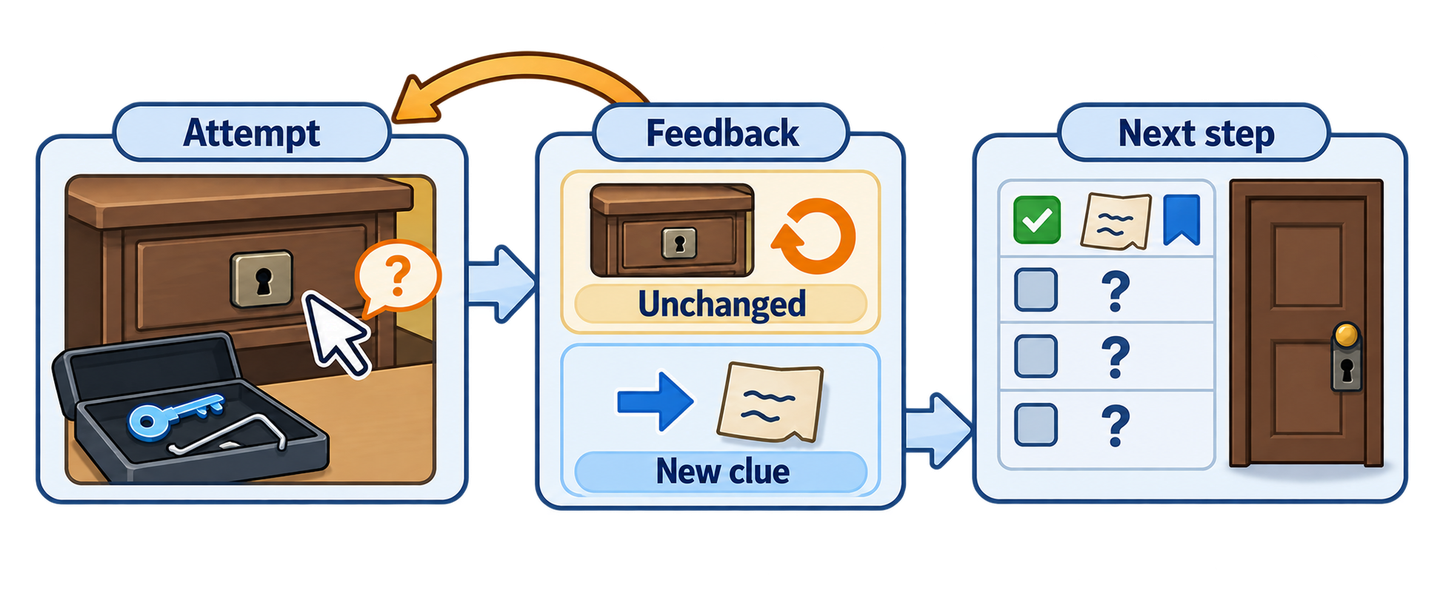
An agent can inspect the same locked object repeatedly, describe several plausible plans and still leave the room exactly as it found it. A long trace makes that activity visible, but it does not establish progress. EscapeBench gives tool reasoning a bounded environment in which actions either affect configured objects or fail to advance the puzzle.

Put the reasoning against an environment
The benchmark uses text-based room-escape scenarios. Its engine organizes scenes, collectible tools and interactive items. The agent can move, click, apply a tool, input text or craft using two tools. Although the action categories are defined, choosing the relevant objects and parameters creates a larger search problem.[1]
Applying and crafting tools are central to the authors' investigation of unconventional tool use. The engine's configured interactions decide whether an attempt changes state; a model saying that a tool ought to work does not make the proposed interaction valid. That boundary lets a trace distinguish hypotheses from completed puzzle actions.[1]
The authors compare language-model agents using steps and hints required to complete scenarios. They also introduce an agent with foresight for proposing and evaluating tool-use hypotheses and reflection for maintaining unresolved tasks. Their reported improvements belong to this benchmark and agent setup, rather than establishing general human creativity or a universal measure of it.[1]
Count what the next action can use
For a developer inspecting an agent trace, a useful action can supply information, change an object or enable another action. An unsuccessful attempt may still be informative if its feedback eliminates a hypothesis. Repeating the same attempt without using that feedback is a different kind of activity.
Hints complicate comparisons because they change the information available to the agent. Keep their content and timing beside the trace. A shorter solution after a revealing hint should not be described as independent discovery. Conversely, a system that needs more steps may be doing a useful exploration the completion count alone cannot explain.
Applying this to your game
Choose a small puzzle with explicitly configured interactions and keep an authored solution as a reference path. Run a bounded agent attempt only if you have a working environment and the resources to inspect its outputs. For each action, record its target, feedback, state change and whether it creates a new useful option. These are proposed checks, not a replication performed by Playable Frontier.
When the agent stalls, inspect whether it missed an available clue, proposed an unsupported tool interaction or failed to retain a result already obtained. Those diagnoses imply different work: revise observation, interaction representation or working memory. Adding another reflection prompt without identifying the missing relation can lengthen the trace without repairing it.
This first inspection gives up a large puzzle collection to understand one chain of dependencies. Maintaining the environment, defining hint policy and reviewing failed attempts all consume effort. If an authored test already checks the intended rule reliably, keep it. An exploratory agent becomes useful when it probes meaningful alternatives that the reference path leaves unexamined.
Compare progress and information use alongside steps, hints and resource use. If the agent finds a supported shortcut, inspect whether it serves the intended puzzle before labeling it a defect or a creative triumph. The benchmark makes action outcomes testable within its scenarios; the designer still decides which outcomes make the game's choices worthwhile. We have not executed EscapeBench or this proposed inspection.
Sources
- EscapeBench: Pushing Language Models to Think Outside the Box
paper · 2412.13549v1 (2024-12-18; arxiv_v1_submission_date) · Source accessed: