A hint can sound clear, give the right answer and let a learner finish a problem. Those are useful properties, but they leave a further question: what can the learner do after the hint is gone? A mathematics tutoring study offers evidence about that question while also showing how much checking happened before generated help reached participants.

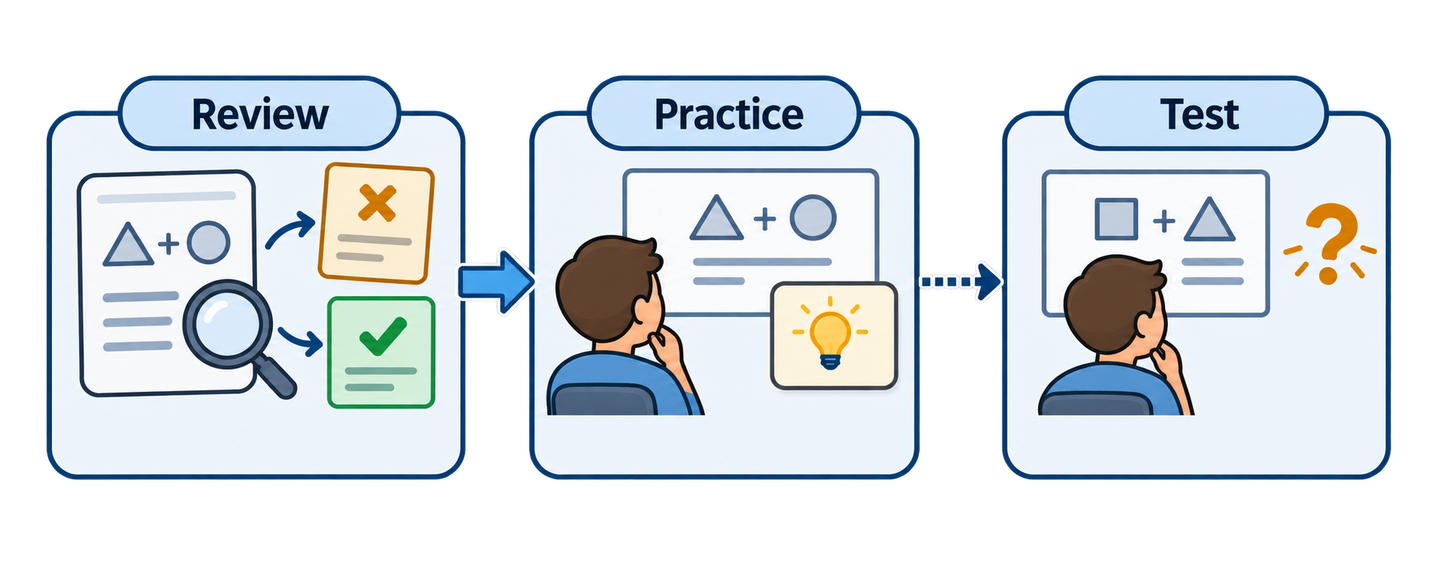
Review belongs inside the intervention
The researchers compared ChatGPT-generated help, human tutor-authored help and a control without the full worked solution across mathematics objectives. The control still supplied correctness feedback and an available bottom-out answer. The procedure included a pretest, a practice phase and a repeated posttest. Participants used help that had been prepared for the study, rather than receiving arbitrary unchecked live generations.[1]
Before the experiment, an author screened all generated hints for a correct answer, correct worked steps and appropriate language. Questions associated with a failing hint were disqualified. The paper separately examined hint quality with additional raters. Removing inaccurate help was part of creating the material used in the learning comparison, not a result that made screening unnecessary.[1]
The analyzed sample showed learning gains with ChatGPT help relative to that control. Differences between generated and human-authored help were not statistically distinguishable in the reported comparison. That supports the usefulness of this reviewed material under the tested conditions. A nonsignificant difference by itself does not prove equivalence across learners, topics or implementations.[1]
Completing with help and learning without it
For an educational game, consider which part of a puzzle the hint should leave to the player. Explaining how to compare two observations differs from supplying the answer. Either can be appropriate, but the learning claim needs a later opportunity that actually tests the intended capability.
The source study's repeated test also matters when interpreting transfer. An improvement on its tested mathematics items does not demonstrate performance on unfamiliar game situations or long-term retention. Those require evidence designed for those questions, rather than an assumption that a fluent explanation transfers automatically.
Applying this to your game
Start with a small, reviewed bank of hints for one puzzle concept. Check each hint against the game's authoritative facts and intended reasoning, including a case where an apparently helpful explanation gives away the comparison. Keep rejected hints and the reasons for rejection so review costs remain visible. This is a proposed authoring process, not a tested game-hint pipeline.
Observe the supported attempt, then plan a suitable uncued problem if your goal is learning. A different problem can help investigate whether the player applies the idea rather than recalls the supplied answer; its difficulty and available evidence must still be comparable to the capability you intend to assess. If immediate relief is the goal, evaluate that experience directly instead of attaching a learning claim.
This first bank gives up live adaptive breadth while letting the team inspect the help people actually receive. It needs authoring, checking and later evaluation work. If an authored explanation serves the same purpose with less correction, keep it. If generated material supplies useful variation without undermining the reasoning, expand only after reviewing those new cases. We have not run the tutoring study or evaluated game learners; its reviewed intervention makes a useful starting point for separating help quality from learning evidence.
Sources
- ChatGPT-generated help produces learning gains equivalent to human tutor-authored help on mathematics skills
paper · publisher_version_of_record (2024-05-24; publisher_publication_date) · Source accessed: