A character can speak in a familiar manner and then make a choice that contradicts the history the player has seen. For a developer, that failure belongs to the character's decision, not just the line's tone. Character is Destiny examines whether language models can select decisions that match fictional characters in their narrative context.

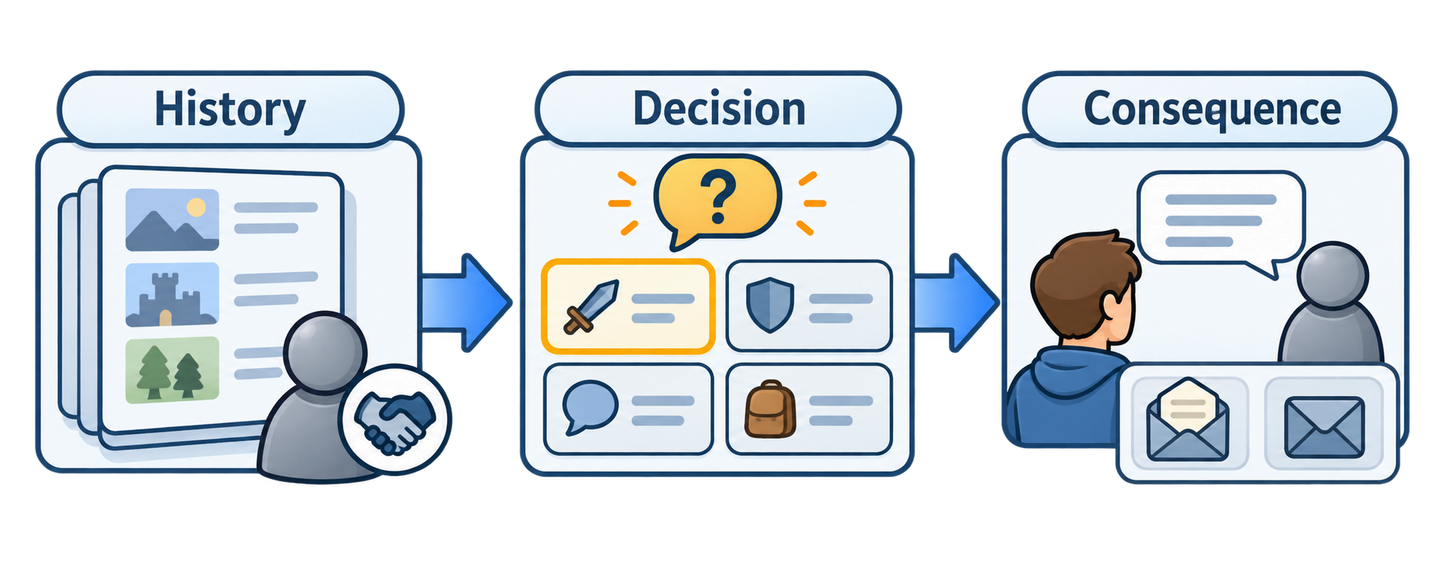
Evaluate a choice with its preceding history
The paper's LifeChoice task supplies preceding book content, the current scenario, a character, a decision question and candidate answers. The evaluation asks the model to choose the decision made in the original narrative. Matching that answer requires finding relevant character information across the earlier text, rather than merely generating plausible dialogue in a named voice.[1]
The authors experiment with character-profile construction and decision reasoning. Their evaluation is anchored to novel-character decisions and selected candidate choices. It does not establish a model of human personality, nor does accuracy against a novel settle whether players would find the corresponding NPC interaction meaningful.[1]
The limitations identify possible leakage from familiar novels despite entity replacement. GPT-4 judges motivation coverage in constructed profiles, while the narrative-choice task uses multiple-choice accuracy; the model-based profile assessment creates a potential bias toward its generations. A model may retrieve a known narrative answer or perform well under a particular judging procedure without showing the general consistency a new character needs.[1]
Consistency needs room for a deliberate change
Suppose an NPC refuses to share a secret, then later agrees. The second decision can be coherent if the player supplied a reason, changed the stakes or earned a new commitment. Demanding the same refusal in every scene would preserve a surface trait while blocking the relationship from changing.
Write down which information the character has and what the player has actually asked them to do. An accusation, a request for confidence and an offer of assistance can create different decision points even when they concern the same fact. A plausible motive does not give the system permission to rewrite a player's act.
Applying this to your game
Author a small set of decision points for a character you control. Record the preceding events, relevant commitments, available choices and reasons the character could accept or refuse. Compare generated decisions with those authored possibilities before adding stylistic wording. This is a proposed character check, not a reproduction of the source benchmark.
Include a legitimate reversal and an inconsistent one. Inspect whether a model uses the changed circumstance or merely repeats the profile label. After a consequential answer, let the player clarify or withdraw their own offer where the scene permits it, and author what that correction changes. Maintaining those consequences is part of the character's work, not a free effect of fluent roleplay.
The smaller option is an authored decision with varied phrasing. It gives up some open-ended choice while keeping the pivotal response inspectable. If people understand the response but find the interaction unrewarding, revise the social act or its consequence before adding a richer persona. If varied circumstances expose meaningful decisions the authored set cannot handle, expand that bounded part. We have not run LifeChoice or tested an NPC; the benchmark helps separate narrative-choice evidence from a convincing voice.
Sources
- Character is Destiny: Can Large Language Models Simulate Persona-Driven Decisions in Role-Playing?
paper · 2404.12138v1 (2024-04-18; arxiv_v1_submission_date) · Source accessed: