Choosing a strong move requires more than explaining why one option looks promising. An opponent can respond, hidden information can change the outcome and an apparently useful action can leave a weak position. PokéChamp places language-model judgments inside a minimax search structure so those judgments contribute to a sequence of possible responses.

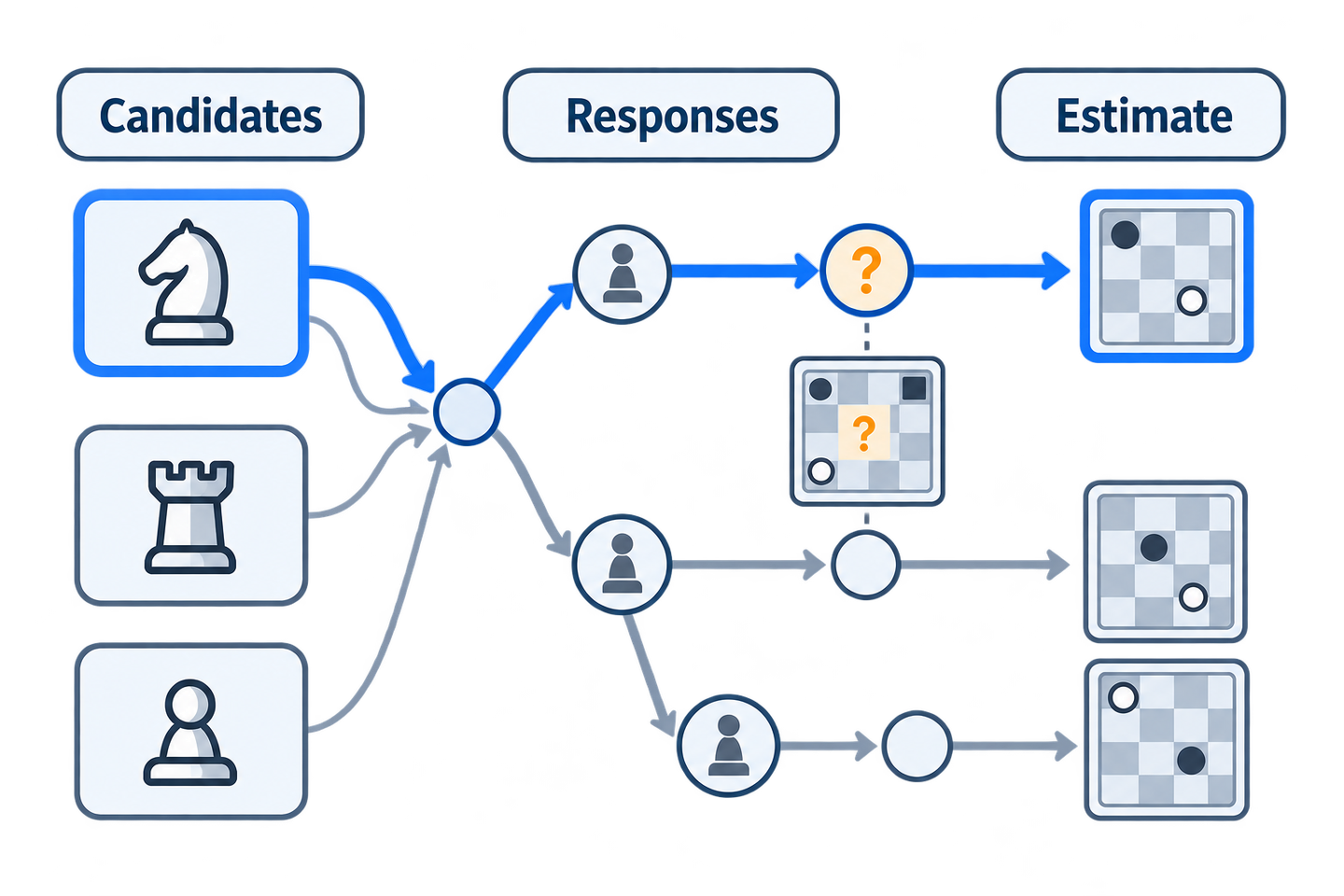
Give each judgment a specific job
The agent uses language models for player-action sampling, opponent modeling and value estimation. Candidate actions form search-tree edges, opponent predictions shape possible responses, and estimated values help compare resulting positions. The search structure connects these contributions to choosing a move rather than treating a fluent recommendation as sufficient.[1]
PokéChamp also approximates transitions under partial observability. It uses Pokémon Showdown statistics and model predictions to estimate hidden information, then a local simulator to produce possible next states. To reduce computation, its implementation uses expected outcomes for stochastic transitions. Those approximations remain part of what the search can conclude.[1]
The paper evaluates the agent in Pokémon battle settings. Its performance does not establish optimal strategy across games or make an opponent prediction true. An action omitted from the candidates cannot earn a favorable value later, and a mistaken hidden-state estimate can make a well-formed search compare the wrong positions.
Inspect the branch that changed the move
For a developer, a useful trace should identify which candidate, opponent response or leaf estimate changed the selected action. That makes a failure more informative than a final explanation alone. A model might never consider the useful move, expect the opponent to cooperate or overvalue the position left afterward.
These diagnoses imply different changes. Expanding search depth does not necessarily repair a missing candidate or an inaccurate transition model. The game rules and available observations determine which comparison the agent can support within its resource budget.
Applying this to your game
Choose a small competitive situation with an inspectable legal-action set. Compare a fixed heuristic or one-step lookahead with a bounded search using model judgments, if you have a working simulator and model access. Record candidates, predicted responses, approximated transitions and the estimates used to rank them. This is a proposed inspection, not a PokéChamp reproduction.
Include a situation where an opponent takes an unexpected legal action. Check whether the selected move depends on excluding that response or treating uncertain information as known. Keep computation and response-time measurements attached to the tested hardware and workload; missing measurements should remain missing.
This first comparison gives up broad battle coverage to understand one consequential choice. Building transitions and reading failed searches compete with adding depth or more model calls. An authored policy can be the better use of work when it already produces the intended challenge. If the bounded search handles meaningful alternatives the smaller policy misses, expand only the relevant branch or estimate.
We have not executed PokéChamp or measured an agent's strength. Its structure helps locate where language-model reasoning enters a competitive decision, while the chosen game and testing budget determine which decisions are worth improving.
Sources
- PokéChamp: an Expert-level Minimax Language Agent
paper · 2503.04094v1 (2025-03-06; arxiv_v1_submission_date) · Source accessed: