A personalization system can raise completion and receive lower ratings from the people who finish. Those results need not cancel each other, but they do prevent a simple claim that the system made the experience better. Zero-Shot Reasoning reports this disagreement in a mobile-game comparison and explains why the opportunity to rate matters.

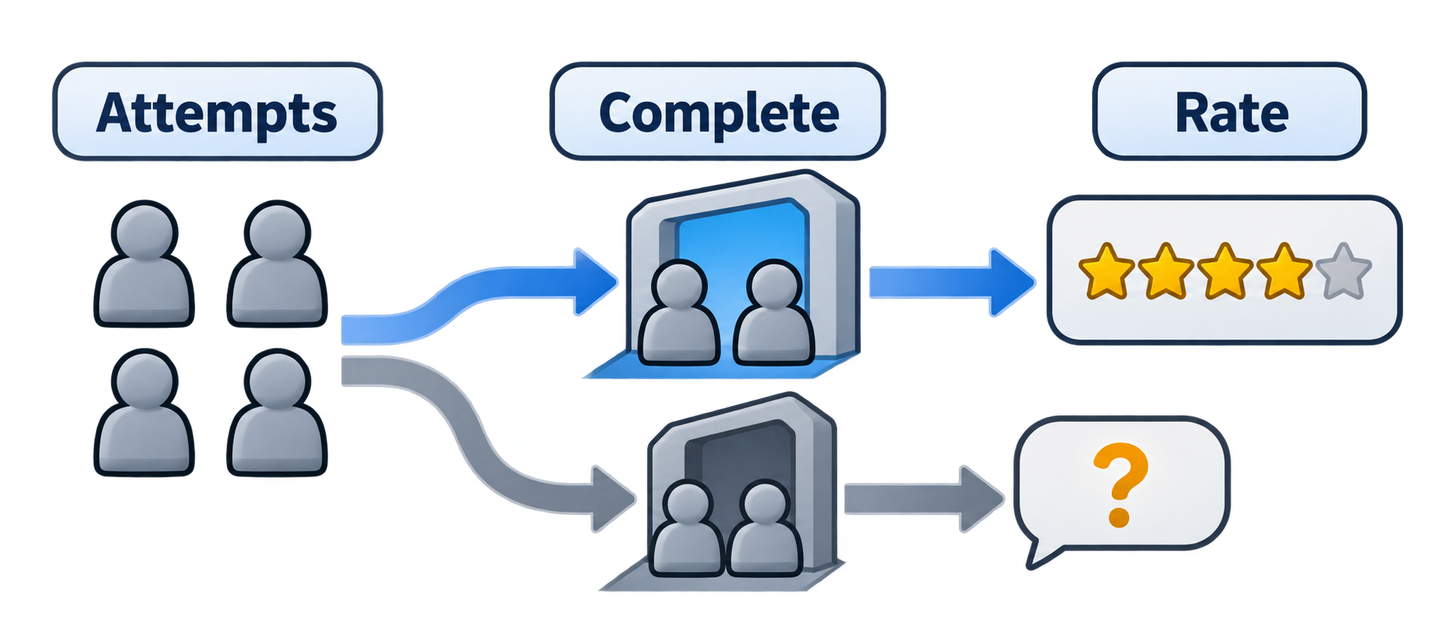
Two outcomes from one intervention
The authors use an LLM to reason about player behavior and provide parameters for personalized level generation. They compare those levels with traditionally generated levels. Players were more likely to complete LLM-generated levels, while average ratings favored the traditional method.[1]
The rating required level completion and a player's voluntary vote afterward. People who abandoned a level did not contribute that rating. The authors note that the traditional generator used a random algorithm without adapting difficulty, and suggest that dissatisfied players in that condition may have left before casting a negative vote.[1]
That is an important possible explanation, not proof that completion represents satisfaction. The compared ratings come from people who remained long enough to provide them, and the intervention itself changes who reaches that point. Neither metric alone identifies the experience of the people who left.[1]
Specify what adaptation should accomplish
Suppose your game lowers difficulty after repeated failures. A higher completion rate could mean the adjustment restored an intended opportunity, made the task trivial or kept frustrated people playing longer. The same numerical direction supports different design interpretations.
The source comparison also combines reasoning-based personalization with a baseline that does not adapt difficulty. It cannot isolate whether an LLM is preferable to every simpler adaptive method. A fixed difficulty rule or explicit choice deserves consideration before a model's sophistication becomes the explanation for the result.
Applying this to your game
Choose the consequence you want an adjustment to change and collect completion and experience evidence separately. Record who can provide each measure, when the measure becomes available and who is absent. Where appropriate, provide a lightweight opportunity to describe why an attempt ended without requiring completion. This is a proposed evaluation, not a correction already tested in the source game.
Compare a narrow fixed adjustment or player-selected setting alongside model-driven personalization if those are realistic alternatives. Inspect what the adaptation does when its inferred player type is wrong, including whether the person can restore their intended challenge. Avoid retaining a motivation label merely because the adjusted level was completed.
This first comparison postpones a large player model. It still needs instrumentation, carefully timed questions and a correction path; asking for a rating after every action can itself obstruct play. Missing responses should remain missing, with their collection conditions visible, rather than becoming a favorable score or a guessed preference.
If completion rises while people knowingly report a less rewarding challenge, revise the adjustment's goal or let them choose it. If the adjusted task restores play they wanted and a simpler rule cannot achieve that result, expand the relevant intervention. We have not run the game or observed its players. The disagreement in the paper is valuable because it keeps the outcome the model optimizes separate from the experience the designer intends.
Sources
- Zero-Shot Reasoning: Personalized Content Generation Without the Cold Start Problem
paper · 2402.10133v1 (2024-02-15; arxiv_v1_submission_date) · Source accessed: