A player who needs a detailed hint now may need less help on the next puzzle. Adaptive Hint Generation for Educational Games uses a fuzzy rule system to vary assistance in a LightBot-style programming game. Its inspectable rules offer a concrete way to discuss how help changes, while its evaluation leaves learning gains open.

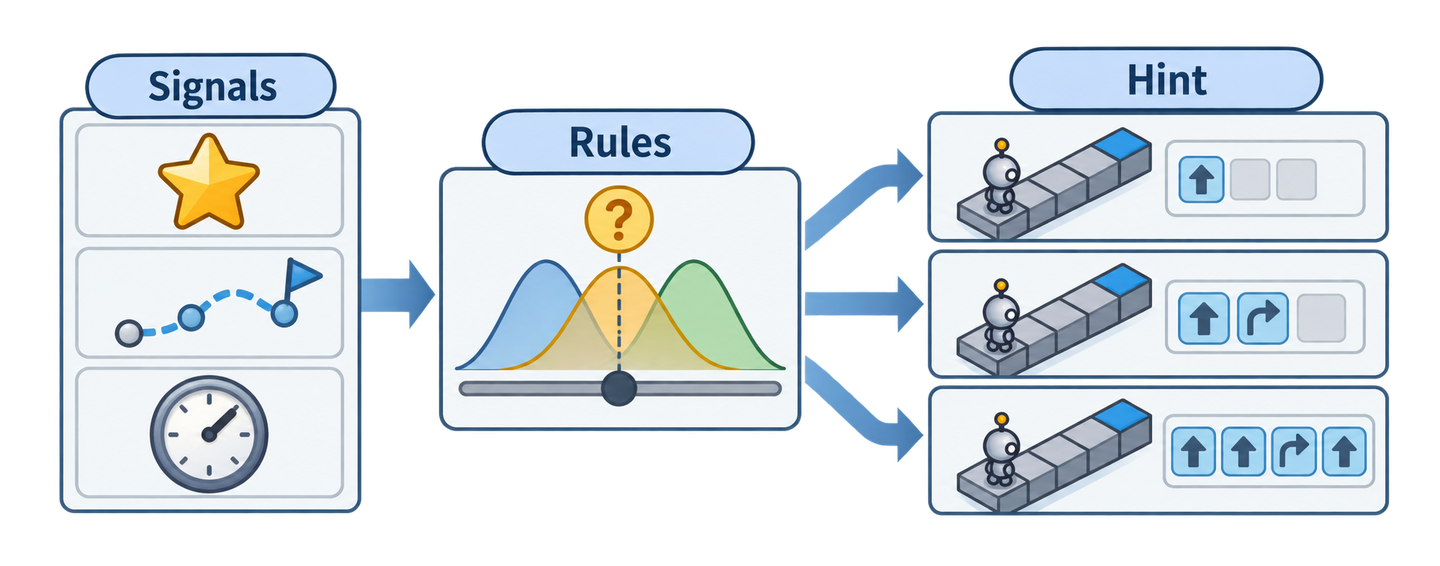
Three signals shape the assistance
Fuzzy LightBot uses average stars from earlier performance, current completion percentage and elapsed time as inputs. Stars reflect the operations used in a solution, completion compares progress with an optimal solution, and time is measured from starting or resetting a level until compiling an incorrect solution. These signals feed rules that infer one of three expertise levels.[1]
The inferred level affects the hint given after an unsuccessful program. A smaller amount of help leaves more puzzle work to the player; a fuller hint supports someone needing more assistance. The model labels are intermediate decisions in this mechanism, rather than independently verified identities of the people playing.[1]
Elapsed time can also reflect reading, distraction or an unfamiliar control. A rule system makes the interpretation inspectable, but inspectability alone does not make that interpretation correct. A reset can change the time signal without changing what the person understands.
Playability is one kind of evidence
The authors evaluate simulated rule outputs and conduct a laboratory playtest with 17 students aged 17–20. Their post-play GUESS-18 results concern the game's reported experience and playability. Students who used hints also answered questions about their helpfulness.[1]
Those observations support a bounded account of use and perceived assistance. They do not isolate a causal improvement in programming knowledge or establish that inferred expertise will transfer to another task. A hint can feel useful because it reveals the answer, because it clarifies an operation or because it helps recover from a control error.
Applying this to your game
Choose one puzzle and a few authored hints that differ in how much reasoning they supply. Write the rule that selects each hint in terms someone maintaining the game can inspect. Include an explicit request for help as an alternative when inferring need from time is unreliable. This is a proposed design comparison, not a tested improvement to Fuzzy LightBot.
Inspect a case where someone waits but already knows the solution, and another where rapid attempts repeat the same misunderstanding. Check whether the rule preserves a useful next decision in both cases. If learning is the goal, later uncued work needs its own observation; finishing with a hint cannot stand in for that evidence.
This first pass postpones a broad expertise model. Authoring hint levels, checking wrong selections and maintaining puzzle-specific rules still compete with making more puzzles. If a single optional hint serves the intended activity, keep it. If the amount of help repeatedly changes what people can meaningfully do next, refine that narrow selection. We have not run this game or assessed its students; the useful contribution here is an inspectable relationship between performance signals and assistance.
Sources
- Adaptive Hint Generation for Educational Games Using Fuzzy Logic
paper · publisher_version_of_record (2025-04-30; publisher_publication_date) · Source accessed: