Returning to a place gives a player a reason to expect continuity. A short sequence of plausible frames may not preserve the same landmark after the camera turns away or the recent context fills up. WorldMem stores previous visual observations with poses and timestamps so generation can consult material outside its immediate window.

What the memory contains
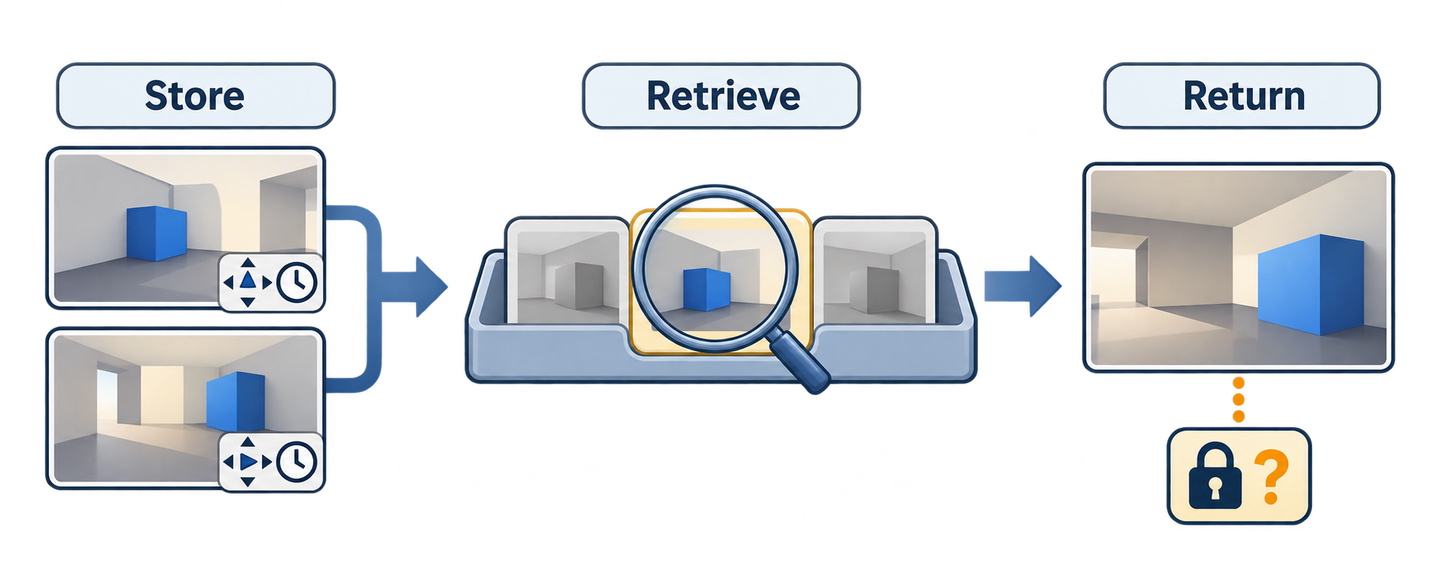
WorldMem's external bank holds memory units comprising frames, pose information and timestamps. A memory block uses cross-attention to condition current generation on selected earlier frames. The system retains visual references rather than relying only on the latest sequence.[1]
Retrieval has to choose among those records because the available conditioning space is limited. The paper uses field-of-view overlap and timestamp differences as confidence measures in a greedy matching procedure, with filtering to reduce redundant units. Viewpoint and time therefore help determine which history influences the next frame.[1]
That mechanism concerns visual reconstruction and generated-scene consistency. It does not by itself store an authoritative inventory, certify that a quest has been completed or decide which player account should survive a correction. A remembered image of an open door is evidence the generator can consult; a committed door state is a separate game responsibility.
A revisit asks more than one question
Consider an illustrative room with a distinctive sign. Turn away, travel elsewhere and return from another angle. One question is whether the room's appearance is recognizably preserved. Another is whether the camera pose used to select memory is reliable. WorldMem's benchmark supplies ground-truth poses from the simulator; the paper discusses predicting poses when they are not directly available. A third question is whether any consequential action made there still governs play.[1]
Those failures require different repairs. Adding more frames might help preserve a landmark while leaving a stale interaction state untouched. If the stored view itself contains an error, retaining it can also retain the error. A continuity promise needs a definition of what counts as the record to honor.
Applying this to your game
Choose one location and one thing worth remembering. With an accessible implementation or comparable prototype, inspect revisits after a viewpoint change and a longer gap. Record the available historical frames, pose information and retrieval decision where exposed. This is a proposed inspection, not our reproduction of WorldMem.
If the place contains a consequential object, keep its authored state check separate from visual resemblance. Include a correction: remove or revise the record that should no longer influence generation, then inspect the return. Do not claim that a convincing frame proves the correction reached inventory or narrative logic.
This first comparison gives up broad world coverage to follow one memory through reuse. Storage, retrieval and correction take maintenance work. An authored landmark or cached scene may keep the same promise more cheaply; a richer memory bank deserves its cost when it preserves useful changes of view that the smaller alternative cannot.
If a player needs an ambiguous recollection rather than a fixed visual match, adjust the promise rather than treating every difference as failure. If a missed landmark blocks navigation, expand that specific continuity check. We have not executed WorldMem or measured long-term player experience. The memory mechanism helps specify which past views generation can consult, while the game still determines what returning should preserve.
Sources
- WORLDMEM: Long-term Consistent World Simulation with Memory
paper · 2504.12369v1 (2025-04-16; arxiv_v1_submission_date) · Source accessed: