An agent can vary its answers without choosing a useful mixed strategy. When an opponent can exploit a predictable pattern, randomization has a strategic job. Do LLMs Know When to Flip a Coin? separates the decision to use randomness from the ability to produce random-looking text.

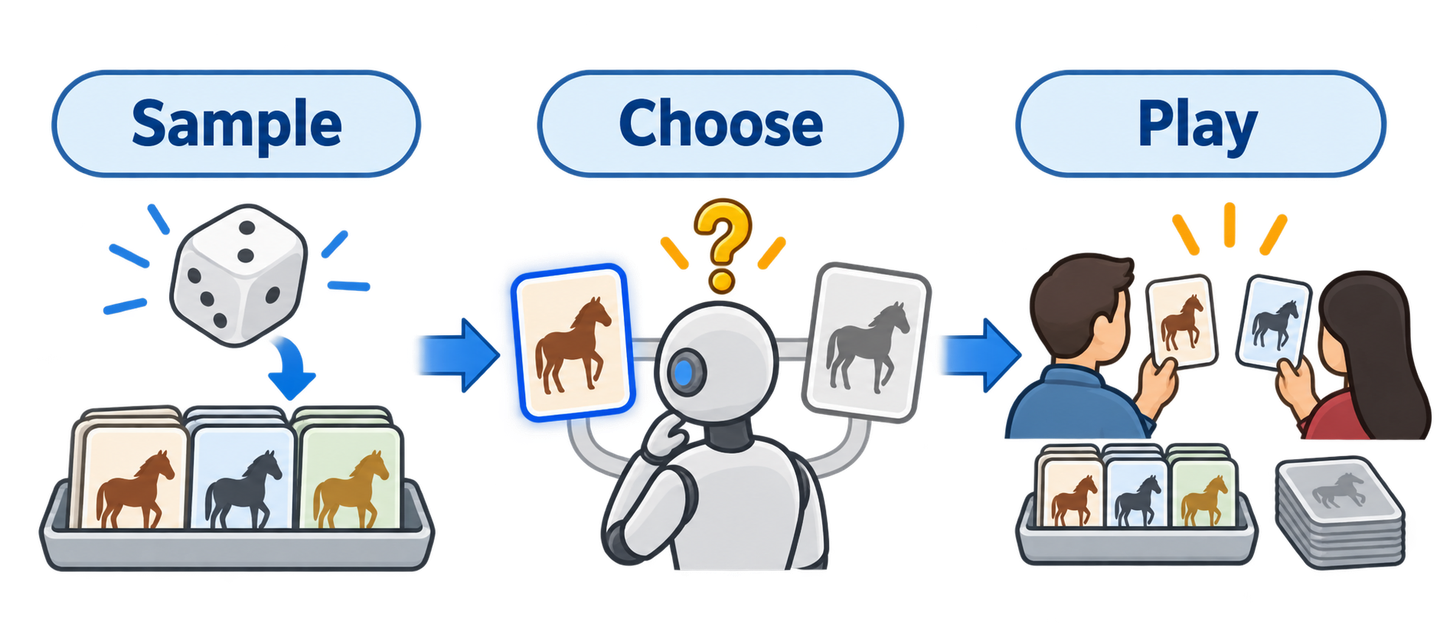
Give randomness an explicit option
The paper builds a symmetric horse-selection game. Players simultaneously choose unused horses with different speeds; used horses cannot return, and round rewards depend on the fastest selection. Under the studied rules, uniform randomization is a mixed-strategy equilibrium. The experimental setting is deliberately simplified and fully observable.[1]
Before each decision, the system offers each language model an externally sampled uniform random choice from its remaining horses. The model can use or ignore that suggestion. This separates strategic willingness to randomize from whether the model itself can generate an appropriate random sample.[1]
The researchers log choices and compare behavior across prompting conditions and opponents. Using a random option is observable within that protocol. It does not prove that every varied output was strategically chosen or that the same behavior would work with hidden information and asymmetric roles.
Predictability has a consequence
For a game designer, the relevant question is what another participant can learn from repeated choices. A bot that always saves its strongest option for last may create a recognizable challenge. That pattern becomes a problem only if exploiting it defeats the intended interaction or prevents meaningful adaptation.
More noise is not automatically the repair. Randomness can obscure a choice the player needed to understand, and a deterministic authored pattern can be useful when recognizing it is the point of play. Specify whether unpredictability should resist exploitation, create variety or communicate a character's disposition.
Applying this to your game
Choose a small competitive situation with a clear legal-action set. Compare an authored predictable policy, an external random policy and a bounded agent that can choose the supplied random option, if you have model access and a working game. Record when the agent uses that option and how a repeated opponent responds. This is a proposed comparison, not a reproduction of the horse-racing experiment.
Include an opponent that exploits the authored pattern and another against which a deliberate response is useful. Keep the payoff rule and information available to each participant visible. A random-looking explanation should not substitute for the recorded selection or its consequence.
This first pass postpones broad bluffing and hidden-information claims. It still takes repeated comparisons and a way to distinguish a bad sample from a bad policy. If a fixed pattern creates the intended learnable challenge, retain it. If predictable choices erase worthwhile competition and a bounded mixed strategy restores it, expand that specific decision.
We have not played the source game or measured an agent's strategy. The paper's controlled setup makes a useful distinction: a system can supply randomness while leaving the agent responsible for deciding when randomness belongs in its move.
Sources
- Do LLMs Know When to Flip a Coin? Strategic Randomization through Reasoning and Experience
paper · 2506.18928v1 (2025-06-21; arxiv_v1_submission_date) · Source accessed: