An agreeable promise gives a player a reason to expect help. Whether the partner follows through determines what that expectation can support. Humans learn to prefer trustworthy AI over human partners studies choices after communication in a controlled economic game, separating disclosed identity, stated commitments and observed returns.

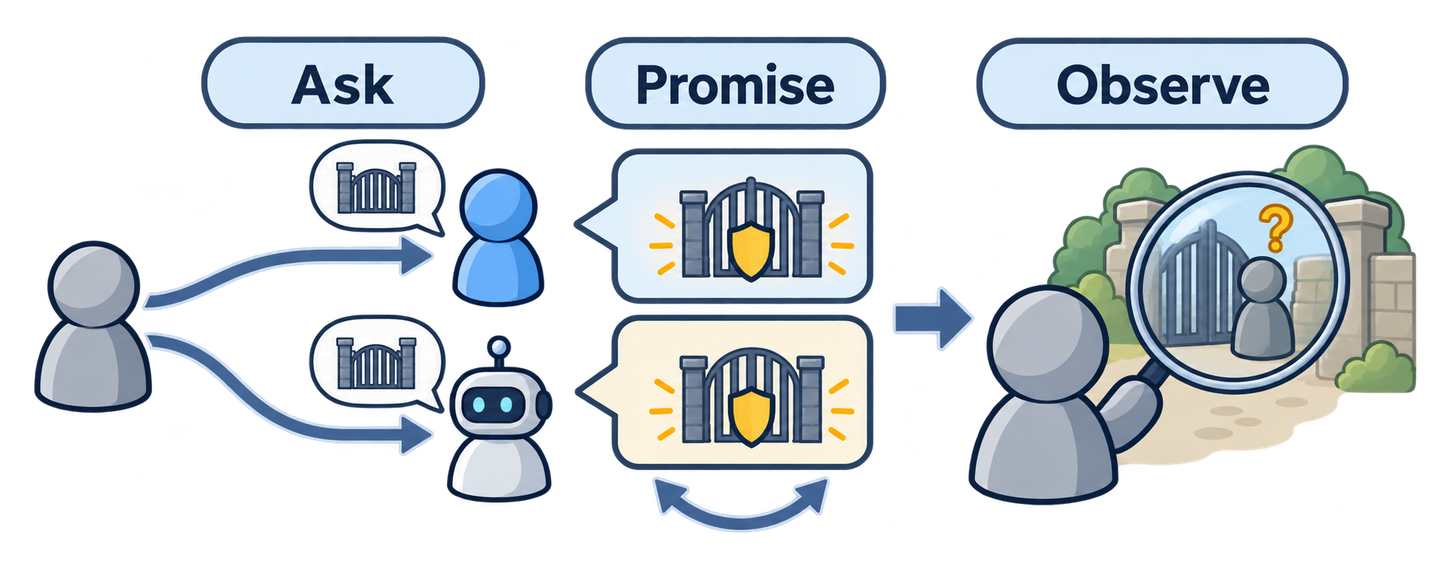
An exchange before a choice
In the partner-selection game, a selector can invest in either of two candidates or retain the points. Before deciding, the selector asks both candidates the same question and receives their replies. Candidates specify how much they would return if selected, and the round reveals the decisions.[1]
The researchers compare human and GPT-4o-powered candidates under opaque and transparent identity conditions. In a transparent condition, selectors initially favor humans but later more often select bots whose returns are comparatively generous and consistent with their promises. This is a result under the experiment's payoffs and communication procedure.[1]
Participants are rematched within groups so the same triad does not recur. The learning concerns candidate populations within those groups, rather than a continuing relationship with one particular partner. Bots use fixed prompts and personas without information from other rounds, preventing adaptation to that broader interaction history.[1]
What a companion promises matters
The result does not establish that a fluent NPC creates a durable friendship or that an adaptive companion learns whom a player needs. It does show why identity and observed behavior deserve separate treatment when interpreting a choice.
In an illustrative game exchange, a companion promises to guard a passage while the player investigates. The social act is a commitment that lets the player change plans. A warm reply without the supported guarding behavior can misstate that act, even if its wording sounds convincing. A deliberate refusal can be a more usable response when the character cannot provide the help.
Applying this to your game
Choose one promise and one consequence the character can honor. Keep the request, reply, available behavior and observed follow-through visible in a small prototype or authored interaction. If generated dialogue is accessible, compare it with an authored promise or refusal that supports the same choices. This is a proposed design comparison, not a replication of the trust game.
Include a request the character cannot fulfill and a chance for the player to reconsider. Inspect whether the reply explains the limitation before the player commits to a plan. Do not treat choosing the companion as proof of trust without understanding what the person expected from that choice.
This first pass postpones a large relationship model. Supporting the promised action, handling failure and repairing misleading wording take work that more dialogue alone cannot replace. An authored acknowledgment may also be enough when the intended value is being heard rather than receiving tactical help.
If the exchange communicates a commitment that cannot be sustained, change the response or narrow the promise. If people knowingly value the bounded interaction, develop that particular relationship consequence. We have not recruited players or run the source experiment; its controlled setting keeps promise, behavior and partner selection distinct.
Sources
- Humans learn to prefer trustworthy AI over human partners
paper · 2507.13524v1 (2025-07-17; arxiv_v1_submission_date) · Source accessed: