An agent may remember that a key is in a cupboard after the key has moved. Keeping the earlier observation can be useful, but treating its extracted relationship as current fact can send the agent back to the wrong place. AriGraph combines semantic relationships with episodic observations so those two forms of memory can support planning together.

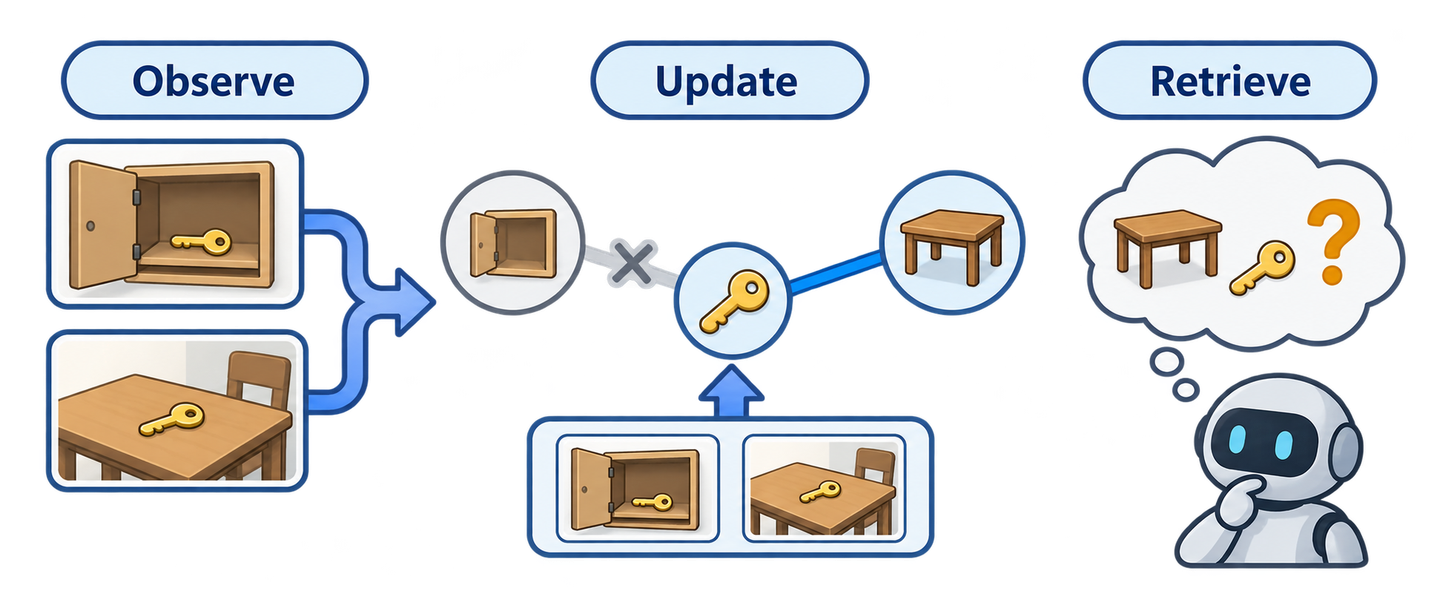
Relations and episodes do different work
From textual environment observations, AriGraph extracts object–relation–object triplets into semantic memory. Episodic nodes retain the observations, and links connect each observation with the relationships extracted at that step. This preserves a connection between a compact fact representation and its originating event.[1]
On a new observation, the agent compares relevant existing relationships with newly extracted triplets, removes those it identifies as outdated and adds the new knowledge. Retrieval searches semantic relationships and related episodes to supply working memory.[1]
The Ariadne architecture then uses that working memory to update a plan and select an action. Its experiments concern text-based tasks including navigation and household-style interactions. These mechanisms do not certify that extraction, contradiction detection or every planned route is correct.[1]
A revision should change the later action
In an illustrative key search, the first observation can remain part of the episode history while the current location relation changes. If the agent retrieves only the earlier episode or fails to replace the relation, a larger memory can preserve the mistake instead of repairing it.
The distinction also matters for narrative games. A character's statement that an object was moved is a statement by that character. Promoting it directly into authoritative world state gives the statement more certainty than its origin warrants. The memory structure can help preserve provenance, while the game determines which record is entitled to change an action.
Applying this to your game
Choose a small fact that changes during play and one later decision that should use its new value. Record the initial observation, extracted relation, correction and retrieved material. If a working implementation is accessible, inspect the selected action after correction. A simple authored state table with an event log provides a useful comparison when the facts are few and explicit.
Include a conflicting statement that the world has not verified. Keep that statement attached to its speaker rather than automatically replacing the committed fact. This is a proposed inspection, not a tested modification to AriGraph or a claim that its source agent implements that authority rule.
This first pass postpones a broad knowledge graph. Extraction, stale-relation checks and reading failed retrievals all require maintenance. More linked records deserve their cost when they support consequential changes the smaller table cannot represent clearly.
If the authored table already preserves the useful commitment, keep it. If the graph recovers relevant history that changes a supported plan, expand that part of memory while retaining correction tests. We have not executed Ariadne or tested player expectations. The useful promise is that a remembered relationship can be traced, revised and applied to the next consequence.
Sources
- AriGraph: Learning Knowledge Graph World Models with Episodic Memory for LLM Agents
paper · 2407.04363v1 (2024-07-05; arxiv_v1_submission_date) · Source accessed: