A programming hint can sound clear while leaving a learner unsure what their code actually changes. DeliverC connects C-pointer practice to a delivery game, where code becomes truck and item actions. That concrete mapping gives designers something to inspect, while the pilot's changing participation limits what its results establish about learning.

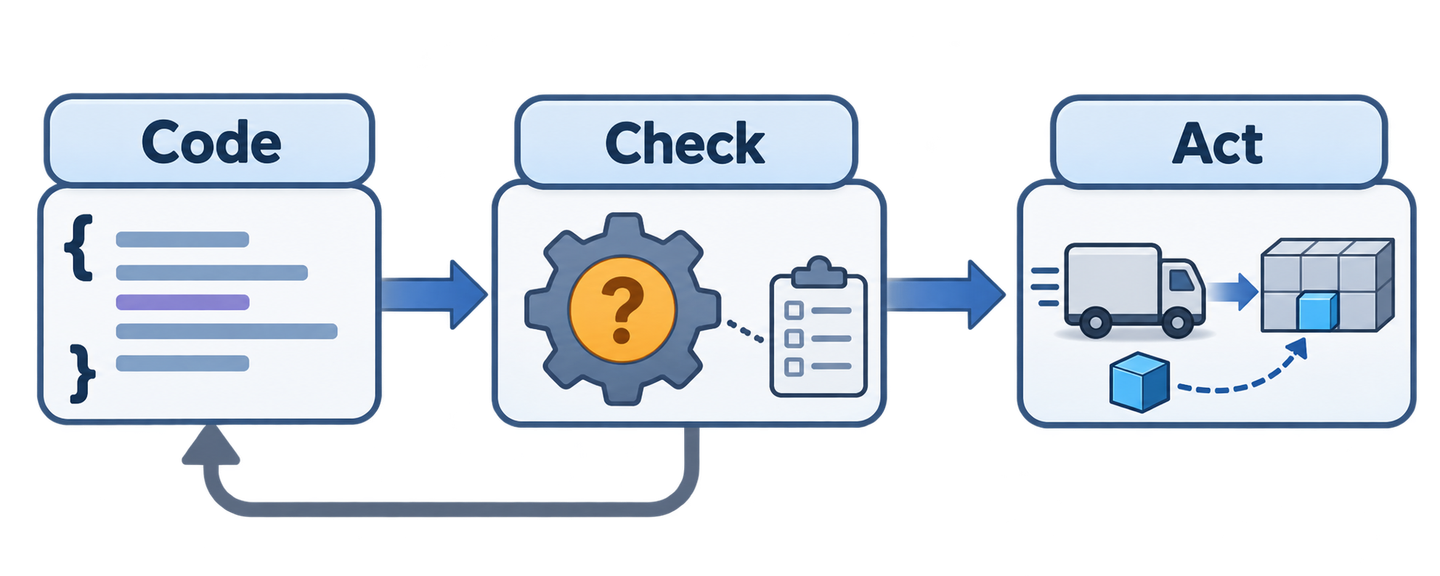
Follow code into an action
DeliverC asks students to write C code for pointer-related tasks. An LLM checks the submission and provides feedback or translates an accepted solution into structured game commands. The delivery truck represents a pointer, locations represent memory blocks and item movement represents data operations.[1]
The source places model reasoning in task generation, code evaluation and command translation. Those are separate responsibilities. A convincing feedback message does not independently prove valid C semantics, and an accepted submission does not guarantee that the animation represents the intended operation. A developer needs to inspect the relationship between all three.[1]
An illustrative pointer assignment should change where the truck points without silently implying that the pointed-to data moved. The metaphor earns its place when the learner can connect the visible consequence to the operation being practiced, including cases that look similar but mean different things.
Keep participation in the result
The pilot occurs in a course with 37 students. Participation is optional and tied to extra credit: 25 attempt the first level, 20 the second and eight the third. The paper reports gameplay patterns, experience surveys and comments, including concerns about unclear feedback.[1]
Fewer attempts among the students reaching a later level cannot alone establish that the game taught pointers. The people still participating have changed, and the optional activity gives several possible reasons for stopping. Positive confidence or experience reports also answer different questions from an uncued performance test.
Applying this to your game
Choose one code operation, an authored correct example and a plausible incorrect example. In a working prototype, compare the submitted code, correctness decision, feedback and animated state change. Use compiler or execution checks where appropriate to the supported code subset, keeping that check distinct from an LLM explanation. This is a proposed implementation boundary, not a mechanism we verified in DeliverC.
Then inspect what the hint supplies and which reasoning remains for the learner. If learning is the goal, later uncued work needs a separate observation. If the goal is simply to make an abstract operation visible, an authored animation and a fixed task can be enough.
This first comparison postpones unlimited task generation. Validating code mappings, repairing misleading feedback and recording why attempts end still take work. Broadening the content before those mappings are inspectable can repeat the same confusion across more exercises.
If the animation misrepresents a supported operation, repair that mapping before generating more hints. If learners can use it to explain a new uncued case, investigate that capability with an appropriate comparison and retain missing-participation evidence. We have not run DeliverC or assessed its students; its prototype makes the code-to-consequence relationship available for a concrete design question.
Sources
- DeliverC: Teaching Pointers through GenAI-Powered Game-Based Learning
paper · 2509.14496v1 (2025-09-18; arxiv_v1_submission_date) · Source accessed: