A route that is convenient for one character can be inaccessible to another. When competitive roles move differently or earn points under different rules, the layout participates in balance. Level the Level studies reinforcement-learning adjustments to maps using explicit agent archetypes, giving designers a way to inspect geometry without pretending the agents represent human preferences.

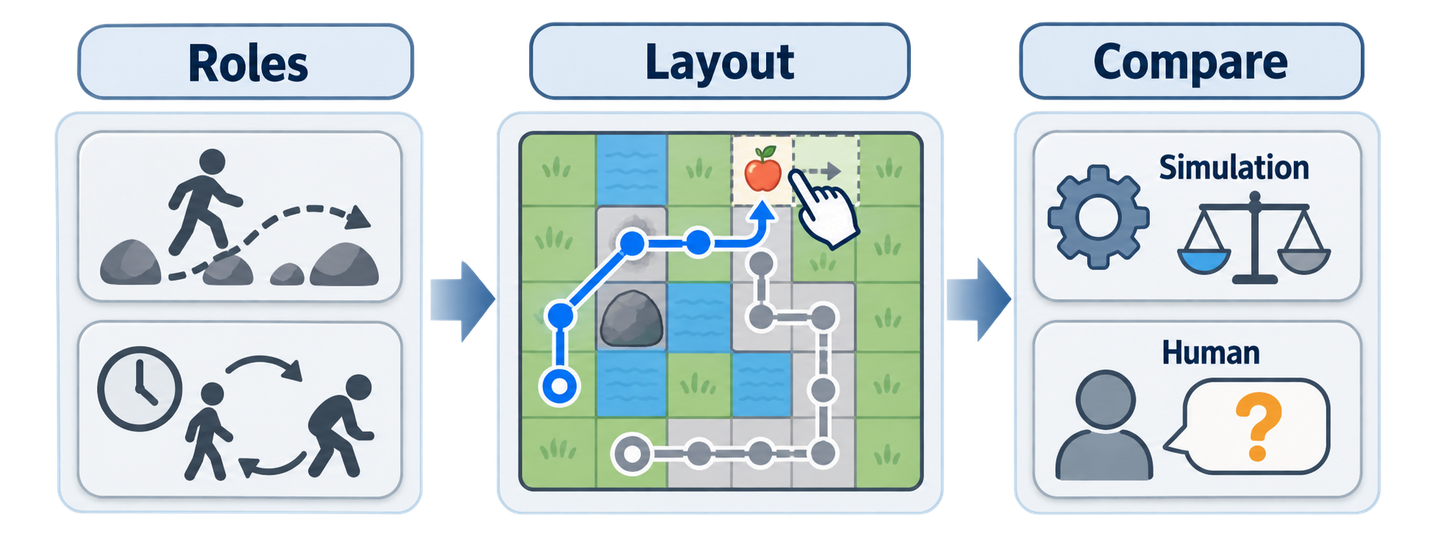
Define the asymmetry before measuring balance
The paper extends a base heuristic agent with several capabilities or disadvantages. One archetype can cross rock tiles, another acts only every second turn, and others need fewer food resources to win. Pathfinding and fixed priorities guide their movement. These are defined policies and game rules, not inferred psychological profiles.[1]
A procedural-content reinforcement-learning method adjusts levels toward balance under those archetypes. The experiments compare it with random and hill-climbing approaches on the same generated level set. The balancing measure concerns simulated outcomes under the specified policies.[1]
That scope makes the comparison useful and limited. Equalized wins under a heuristic do not establish that people perceive the roles as fair, that the map remains interesting or that other strategies are supported. A character whose route is longer could still offer a valued ability the simulation does not model.
The layout changes what the role can do
Consider an illustrative rock-crossing role and a slower role. Moving a resource can change who reaches it first without changing either character's rules. It can also eliminate a useful contest, make an alternative path irrelevant or turn the slower role's decision into waiting.
Those consequences belong in the design question. A balancing target should preserve the actions that make the asymmetric roles worth choosing. If equalizing one outcome removes that difference, revise the target rather than declaring the level better because its simulated score improved.
Applying this to your game
Choose two explicit capabilities and a small authored map. Compare their accessible routes and contested resources under simple policies before adding a learned layout editor. If a simulation is available, keep its behavior, win condition and tested map version attached to the result. This is a proposed comparison, not a reproduction of Level the Level.
Include an alternative policy that pursues a different route. Check whether the layout's apparent balance depends on one narrow heuristic. Human accounts of understandable options and fairness need a separate observation; a simulated win rate cannot supply them.
This first pass postpones a broad archetype library. Building credible policies, inspecting altered layouts and restoring lost routes all cost work. A hand-placed resource or fixed role adjustment can be the better option when it preserves the intended contest directly.
If the simpler change supports the roles without flattening them, keep it. If a learned editor finds useful layouts the smaller method misses, expand those cases while retaining the policies' limitations. We have not trained the system or observed players. The paper helps make capability and geometry part of one balance question, with player interpretation still open.
Sources
- Level the Level: Balancing Game Levels for Asymmetric Player Archetypes With Reinforcement Learning
paper · 2503.24099v1 (2025-03-31; arxiv_v1_submission_date) · Source accessed: