A quest giver needs to explain an available task consistently. A suspect may need room to hesitate, evade or revise an account. Symbolically Scaffolded Play examines prompting constraints through these different narrative responsibilities, while keeping human usability observations separate from synthetic evaluations of dialogue.

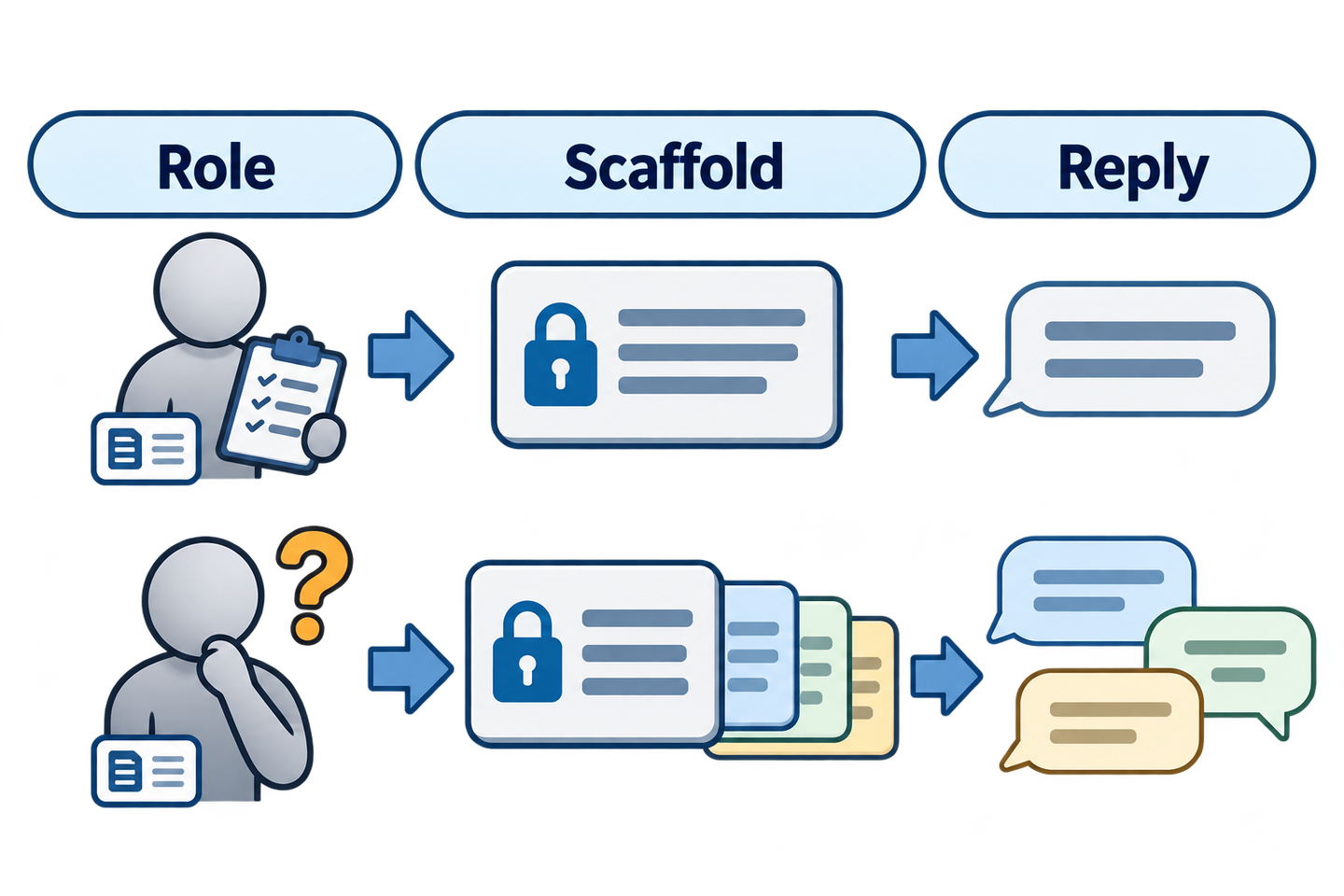
What each comparison can show
The paper's small within-participant usability study compares high- and low-constraint prompts. It reports no statistically reliable experiential differences after correction. First-play problems such as navigation, turn-taking and unclear instructions remain visible in participant feedback. The null comparison does not establish equivalence or show that constraints never matter.[1]
A later synthetic evaluation compares the high-constraint baseline with redesigned JSON-and-retrieval scaffolding. Retrieved lore and dialogue history combine with relevant character-state rules to form the prompt. A model judge assesses repeated scripted interactions for variation, relevance and contradictions.[1]
Those synthetic probes report different tradeoffs by role. The source's role table emphasizes greater stability for the interviewer-like narrative anchor and reduced improvisational freedom for Mark, a suspect whose role needs alibis. Sarah's supporting-role results are mixed and context-dependent, with minor clarity gains. These are model-assessed outputs rather than human findings that the redesigned system improves a player's experience.[1]
Constrain the act that needs protection
In an illustrative quest exchange, contradicting the task requirement can leave the player unable to plan. In an interrogation, a bounded refusal or changing explanation may support the encounter's intended uncertainty. The same reduction in variation can protect one act and obstruct another.
A character still needs a supported response to what the player means. Making every sentence consistent with a schema does not establish that the player can distinguish an accusation from a request for clarification, or understand what follows after either choice.
Applying this to your game
Choose one reliable instruction and one exchange where improvisation has a purpose. State which facts each character must preserve and which responses may vary. Compare a few authored alternatives with a bounded generated version if model access is available. This is a proposed role comparison, not a tested redesign of the source prototype.
Include a player who rejects the offered interpretation. Inspect whether the character keeps the necessary facts while allowing a meaningful reconsideration. Keep model-judge scores distinct from any human account of clarity, tension or enjoyment; they can prompt inspection without supplying that account.
This first pass postpones a universal prompt policy. Authoring supported acts, maintaining state rules, checking retrieval and repairing misleading responses still cost work. A fixed quest instruction can protect the critical route more directly, leaving generation only where variation supports the intended social encounter.
If the constrained reply erases a useful intention, change its rules or author another response. If improvisation repeatedly contradicts a commitment the player needs, narrow that act. We have not run the prototype or observed participants. Role-sensitive constraints are a design question about what the exchange must let the player do, with separate evidence for output stability and experienced value.
Sources
- Symbolically Scaffolded Play: Designing Role-Sensitive Prompts for Generative NPC Dialogue
paper · 2510.25820v1 (2025-10-29; arxiv_v1_submission_date) · Source accessed: