An agent can produce a plausible account of success while stopping before the required consequence occurs. SIMA 2 evaluates instruction-following across virtual worlds, and its paper distinguishes success checks according to what each environment exposes. That distinction matters when a developer compares agents or decides whether a generated action achieved its job.

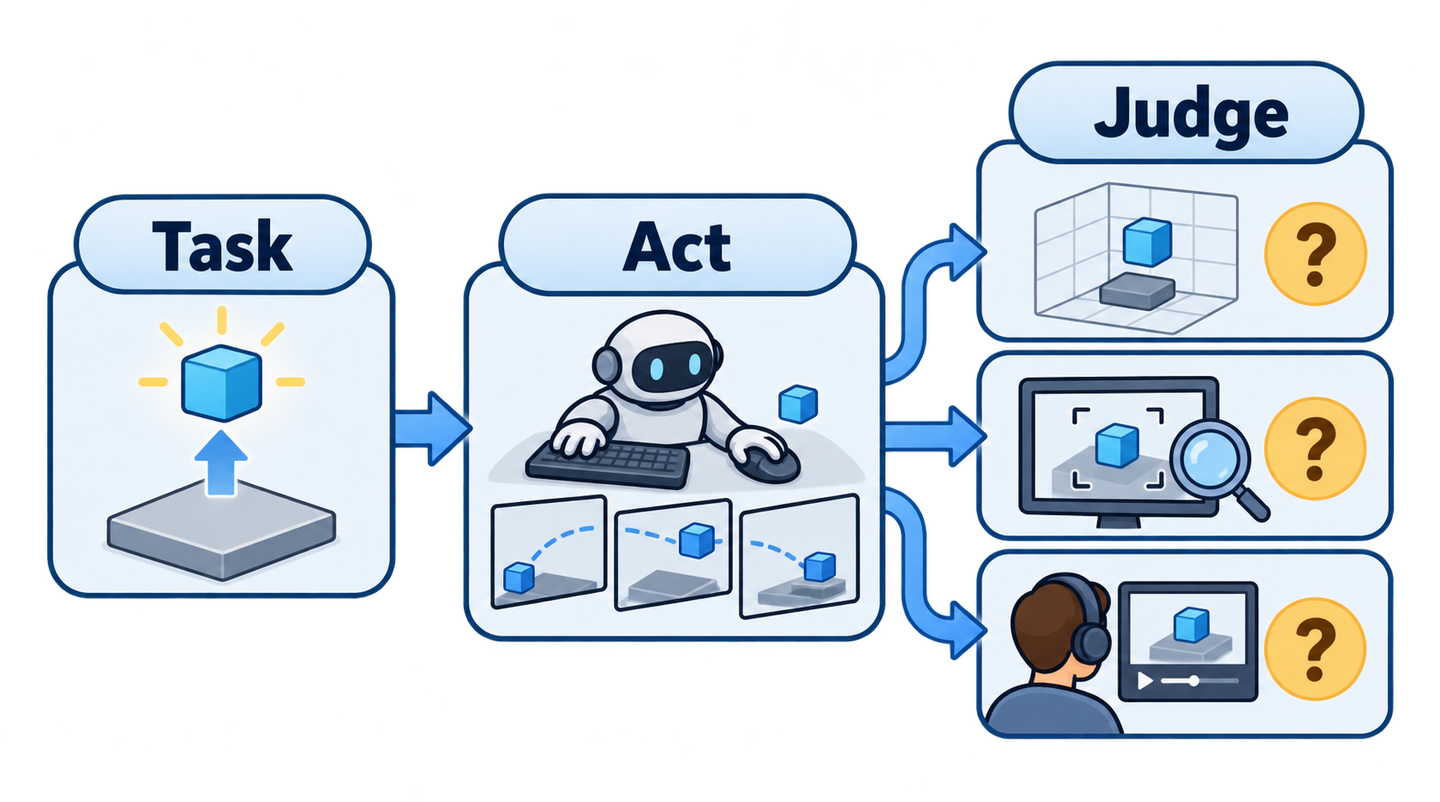
Three routes to judging completion
Ground-truth evaluations inspect environment state, such as object positions, acquired resources or triggered mechanics. In the paper, this access is available in research environments rather than generally exposed by commercial games.[1]
Programmatic evaluations instead use screen information and keyboard-and-mouse actions. Optical character recognition, pixel colors and action functions support scalable checks, but each manually authored function is limited to outcomes those observations can detect.[1]
For other tasks, human raters watch an agent trajectory and assess completion. The researchers collect multiple independent judgments because raters do not always agree. This broader evaluation has a different cost and uncertainty from an automatic state check.[1]
These routes support different claims. A detected popup can be a useful signal without proving every object is in the intended state. A human's interpretation can assess a broader action without becoming an exact engine-state query. Combining the results requires preserving which route judged each task.
The success function shapes the behavior rewarded
The source describes improvements such as requiring relevant on-screen text to persist for several seconds rather than triggering success on its first appearance. That change makes a transient cue less likely to count as intentional completion.[1]
For an illustrative collection task, opening a resource menu differs from acquiring the resource. If the evaluator rewards the menu alone, a stronger score can reflect behavior the designer did not intend. The agent's explanation should not settle that mismatch.
Applying this to your game
Choose one instruction and define the observable consequence before comparing agents. Use an authoritative state check where it is available; otherwise document the visual or action proxy and its known failure cases. If human interpretation is needed, retain the judgment procedure and disagreements. This is a proposed evaluation, not our reproduction of SIMA 2.
Include a near-success case that shows the expected cue without completing the underlying task. Check whether the evaluator distinguishes it and whether the player still has a useful way to continue. A deterministic authored action sequence can test the success function before model-driven behavior adds more uncertainty.
This first pass postpones a broad generalist benchmark. Writing task checks, reviewing disputed trajectories and maintaining environment versions all require work. The paper also identifies limits involving long tasks, short interaction memory and precise low-level control; those limits remain relevant despite an impressive completed example.[1]
If the check rewards the wrong event, repair it before ranking agents. If the bounded check reliably captures the required consequence, expand to another clearly defined task. We have not executed SIMA 2 or measured generalization. An instruction becomes evaluable when its consequence and the method judging that consequence remain visible together.
Sources
- SIMA 2: A Generalist Embodied Agent for Virtual Worlds
paper · 2512.04797v1 (2025-12-04; arxiv_v1_submission_date) · Source accessed: