A player can suspect a character without wanting to accuse them. If a dialogue system turns that suspicion into an accusation, a fluent reply may take the scene somewhere the player never intended. Before deciding how freely a character can answer, decide how the player tells the game what they mean.

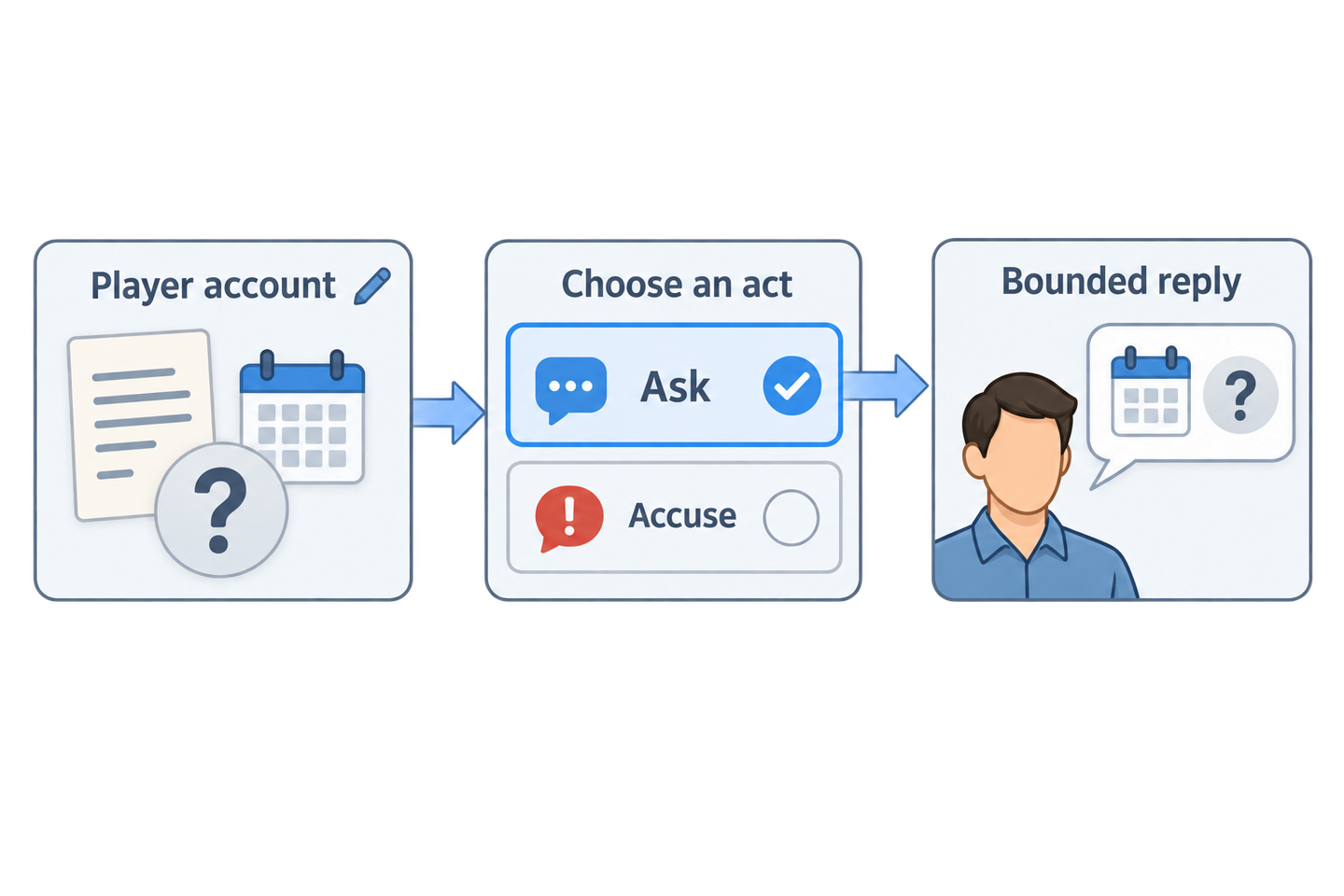
Make an interpretation something the player can edit
Emily Short describes a hypothesis-building interface in Mask of the Rose. Players combine evidence into possible accounts, including unknown elements; a completed hypothesis opens dialogue. Constraints exclude some impossible combinations. Short also distinguishes what the game records from what a player remembers or concludes. Her post explains a design and its intentions; it does not report a controlled test of this interface.[1]
That distinction offers a useful starting point for a conversational prototype. A record that the player found a letter does not establish what they think it means. You can let them choose or edit a small account, then show how the game understood it before they bring it to a character. Keep revealed evidence separate from hidden world facts. Decide which contradictions this scene can disclose, and retain uncertainty where the player cannot yet know the answer. A plausible theory should not be silently rejected merely because it conflicts with the hidden solution.
In a hypothetical mystery scene, let the player connect a letter, a meeting and an unknown motive. Then let them choose whether to ask about the meeting, share their concern or make an accusation. Those acts use the same account but place different demands on the character. Showing the selected act before sending it gives the player a chance to change it.
For example, suppose the character knows when they met the letter’s author but does not know why the letter was written. The player selects Ask and asks whether the meeting happened before the letter arrived. The character confirms that timing and says they do not know the motive. The player can revise the timeline or keep investigating without the game converting suspicion into guilt. This is an invented exchange illustrating the proposed boundary, rather than dialogue from Mask of the Rose.
The response needs a purpose
For the first authored exchange, decide what answering contributes. A question might reveal another event. Sharing concern might receive an acknowledgment that the player values. An accusation might change whether the character is willing to help. The point is to define why this person is being addressed, including a social value that need not open a new tactical option.
Keep the character’s knowledge separate from the player’s account and the game’s established facts. If you later use an LLM to phrase the response, pass those distinctions deliberately and inspect whether the output preserves them. A reply that confirms an unsupported motive can change the mystery even when the words sound appropriate. This separation is our proposed implementation boundary, not a system evaluated in Short’s post.
Applying this to your game
Begin with one account, an unknown element and an editable choice of speech act. Write the responses by hand before adding generated wording. Invite an account of the person’s intended approach before showing the offered acts, then inspect which intentions the choices support or miss. Let them revise or decline before sending. After the exchange, ask separately what they understood the response to do and whether it supplied something they wanted from addressing the character. These observations inform local authoring; repeated visits or different people seeing different versions do not prove causal effectiveness.
This limits the work to a few supported intentions and responses, giving up unrestricted conversation for this iteration. The author still has to write refusals and uncertainty. The programmer has to carry the selected interpretation into the response without promoting it to a fact. Allow account and act changes before sending. If an accusation reduces willingness to help, author one later opportunity to explain or withdraw it, while stating which consequence remains; changing the account alone does not undo the accusation. Plan that repair alongside the first exchange, or defer the accusation branch. A larger hypothesis board would also need combination rules and more response coverage.
Also try a reasonable theory that conflicts with a fact the player has not yet discovered. Inspect what the interface rejects, what the character can say, and which uncertainty remains. Visible feedback should follow the scene’s intended disclosure policy. This checks the proposed boundary between available evidence and hidden truth; it does not verify the player’s interpretation against an answer key.
If people cannot express a reasonable intention, expand or revise the acts before decorating the replies. If they can express it but the editable account is burdensome, compare a simpler question menu. If addressing the character contributes no useful act or knowingly valued acknowledgment, a direct evidence notebook may be the better use of this iteration. An inconclusive session does not justify adding more conversational machinery.
Keep filtering open to revision
Short’s later reply explains why the team filtered dialogue: she wanted several options that suited a character’s presentation without overwhelming readers or forcing a choice between social style and the scene’s goal. That is an intention for a particular game and audience, rather than evidence that filtering suits every roleplaying experience.[1]
Filtering can also hide the approach a player wants to take. Preserve a visible way to revise the account, change the act or leave the conversation, and inspect missing intentions in the first comparison. A prototype may deliberately support uncertainty or awkwardness; ask whether that experience serves the scene before making every response more explicit.
We have not played Mask of the Rose or run this prototype. The authored case motivates an evaluation question: can the player communicate an interpretation without the game deciding it for them? A small structured account may help answer that question, but it cannot represent everything a player can mean. The intended narrative and available authoring effort determine which omissions are acceptable.
Sources
- Dialogue Expressiveness in Mask of the Rose
article · November22,2023 authored post and June12,2024 author reply, as returned2026-10-13 · Source accessed: