The Risk of Over-Recording Exploratory Dialogue

In interactive narrative systems, players frequently engage in conversational browsing. They ask background questions, probe an interlocutor's temperament, or test conversational tones without intending to alter their character's permanent standing in the world. When a system naively logs every selected option into global history—whether through indiscriminate save-state flags or rolling natural-language conversation logs—casual exploration transforms into accidental commitment. A player who merely inquired about an NPC's past finds that inquiry treated as a permanent accusation or an irreversible promise.[1]
The documentation for the Ink scripting language outlines a structural solution to this problem: separating transient narrative flow from persistent state tracking. In Ink's baseline weave architecture, choices branch local narrative flow, but lines of content remain unaddressed by default. Once the flow passes through a gather point, the specific path taken through those choices is dropped from queryable memory unless the author explicitly assigns an address label.[1]
Three Architectural Primitives for Scoped State
To keep casual exploration cheap and durable consequences deliberate, narrative architectures can rely on three lightweight primitives documented in Ink's flow model:[1]
First, unlabelled weaves and gather points handle immediate conversational texture. Because basic weave paths lack addresses, an author can present three distinct ways to react to a line of dialogue, funnel them back into a single gather, and guarantee forward progression without polluting the global state space with read counts or flags that subsequent scenes might misinterpret.[1]
Second, temporary variables provide scratch logic that automatically expires. In Ink, variables declared with the temp keyword are discarded as soon as story flow exits the stitch in which they were created. They enable complex multi-step dialogue calculations, such as tracking how many polite remarks were made in a single room, without keeping those counters as global variables after the stitch ends.[1]
Third, explicit multi-valued lists manage durable narrative facts. Ink implements lists as sets of named states and properties that support explicit set operations like addition, subtraction, and intersection. Rather than inferring player intent from conversational history, the engine records binding commitments only when narrative flow explicitly transitions a list element, such as registering that an alibi has been formally submitted or a piece of evidence handed over.[1]
Applying This to Your Game
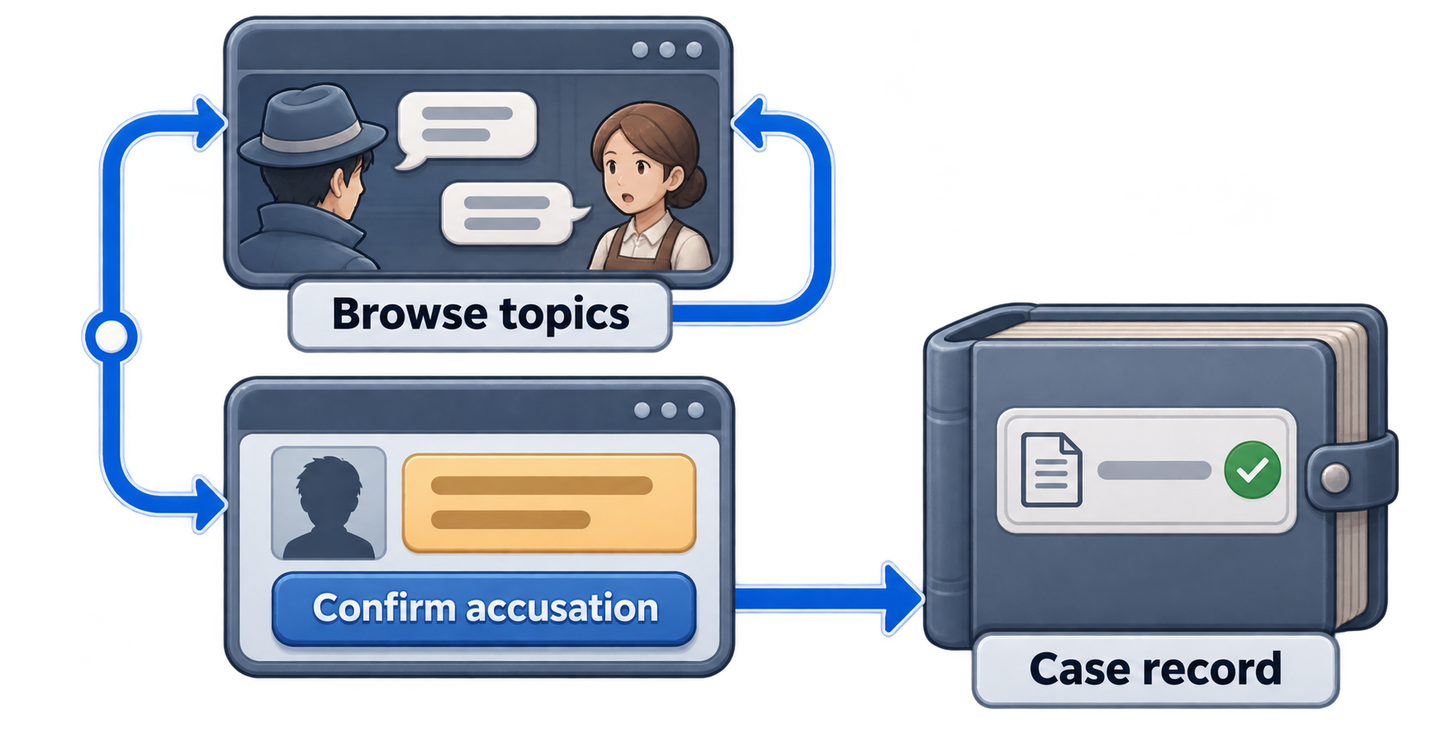
When building an interrogation or social deduction encounter, designers can implement an explicit two-tier dialogue flow. In this proposed structure, an unlabelled weave loop serves as an investigation hub where players can exhaust background topics—such as asking a suspect about the weather, room furnishings, or general routines—without setting persistent flags. These choices use transient flow to convey character voice and deliver clues directly to the human player.
An "Accuse" option opens a labelled confirmation stitch. Within that stitch, keep the selected suspect in a temporary variable for the pending accusation. "Revise" replaces that value; "Withdraw" returns to browsing without updating the global list. Show the selected suspect and the consequence before offering "Confirm accusation". Only confirmation adds the corresponding accusation entry to a global list and enters the confrontation scene, whose logic reads that confirmed entry to choose the NPC's response. This proposed flow lets players correct a provisional account before it becomes binding. After confirmation, the accusation is fixed for that encounter. Authors must build the confirmation controls and downstream responses for the accounts they support.
Test the same dialogue, clues, confirmation controls and confrontation consequences in two builds. One retains background-topic flags for later callbacks; the other retains only confirmed accusations. Compare optional topics explored, hesitation before optional choices, successful corrections, and whether players can predict which account the confrontation will use. If the leaner build offers no exploration benefit, keep the simpler existing implementation. If an omitted callback breaks continuity that players reasonably expect and changes their choices, retain a flag for that topic. These findings would favor specific authored callbacks over a blanket forgetting rule. Budget the confirmation controls and the downstream branches they require; support fewer accounts if that work displaces essential clue feedback. Test that the confrontation reads the corrected account. A consequential branch without a usable label or explicit state write can still be unavailable to later scenes.
Sources
- Writing with ink
documentation · inkle/ink master documentation, Part3 Global Variables, Logic and Conditional blocks; live October26,2026, exact raw snapshot retained; commit not pinned · Source accessed: