A circuit puzzle asks the player to route power through matching connectors. The tutorial can animate the entire solution, leave the player to experiment or demonstrate one connection and hand control back. Those choices leave different work for the player. Start by naming the relation the next move should require them to use.
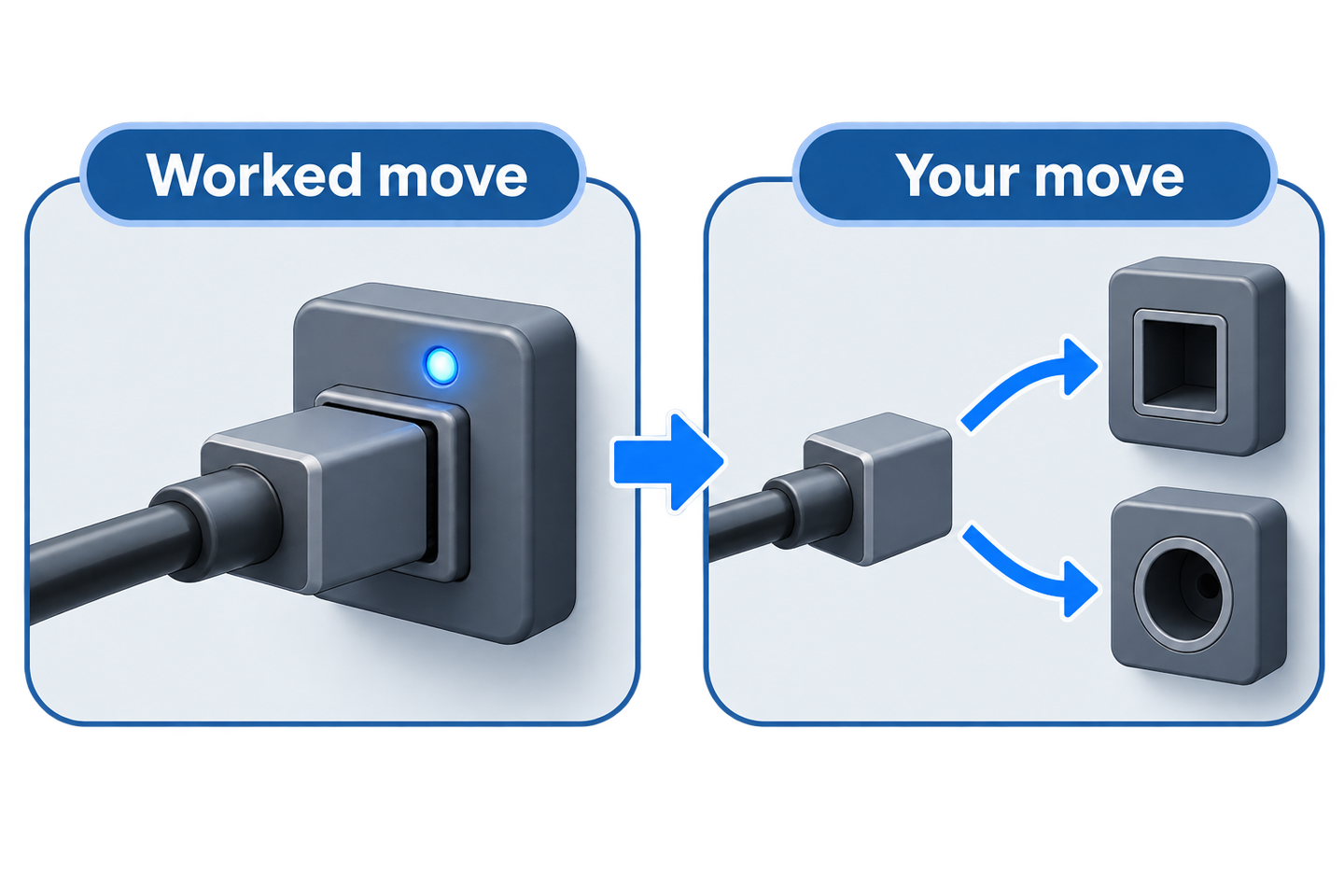
Suppose the intended lesson is that matching connector shapes carry power, while cable color does not matter. Show a square plug joining a square socket, then offer a different arrangement in which the player must choose the matching shape. This is a proposed teaching example. A successful click after the animation would show that the player completed that step; by itself, it would not tell the team which feature they used.
Koedinger, Pavlik, McLaren and Aleven’s 2008 assistance-dilemma paper discusses instruction ranging from problems alone to combinations of worked examples and problems, through to examples alone (pp2158–2159). It treats the conditions for combining assistance and independent work as a research problem. It also distinguishes immediate supported performance from later retention, transfer or future learning. The synthesis motivates a comparison; it supplies no validated tutorial ratio for this circuit game.[1]
Make the example’s reason visible
Animate the square connection slowly enough to see the two shapes meet, and show power arriving at the lamp. Keep the explanatory cue beside that change. If the animation instead highlights every cable of the same color, it can teach a shortcut that the next puzzle does not honor. The demonstration needs to expose the relation the designer wants the player to inspect.
When control returns, keep the rule available in the objects themselves. Change the connector positions and colors so copying the previous location is insufficient. Avoid adding a timer, a camera change or an unfamiliar control at the same moment. Those additions would make it harder to tell whether the demonstrated relation was usable.

Applying this to your game
Build one authored demonstration and one short playable arrangement using existing connectors. Let the designer specify the relation and the next decision; let the developer control the handoff and provide a way to replay or skip the demonstration. Defer an adaptive tutorial model. This limits content coverage, but it lets the team inspect a specific teaching choice before funding many examples or ability classifications.
For an initial comparison, keep the playable arrangement and feedback the same while varying whether players receive the one-move demonstration or the existing instruction. Provide an equivalent static sequence or concise explanation for players who cannot use the animation, and keep that access support consistent across the comparison. Allow relevant help in either version and record when it supplies the answer. Look at which connector players choose, what they inspect and whether they can use the relation in the changed arrangement. A brief question can clarify their reasoning, but action and explanation can disagree; neither should automatically erase the other.
Count the time spent watching, restarting and recovering from errors as part of the tutorial’s cost. If the demonstration speeds the first move but forces confident players to wait, make it optional or shorten it. If it removes a discovery that players value, use a smaller cue. If people still cannot tell what makes a valid connection, a direct explanation of the rule may serve them better than repeatedly replaying the animation.
Choose what the comparison can establish
A later connection without the animation can help distinguish following the displayed move from using the relation elsewhere in the same session. It cannot establish long-term retention. A later visit or a different task would require additional observations and time. If the game only needs to get players comfortably into play, evaluate that goal directly instead of adding an unwanted lesson to satisfy a learning claim.
Keep the one-move version only if it earns its interruption. Players may already understand the connectors, or the puzzle’s feedback may explain the rule more clearly during play. In those cases, remove the demonstration and spend the content time on better feedback. The useful outcome is a deliberate allocation of assistance around the next decision, with enough evidence to revise it.
Sources
- Is it Better to Give than to Receive? The Assistance Dilemma as a Fundamental Unsolved Problem in the Cognitive Science of Learning and Instruction
paper · CogSci 2008, pp2155–2160; author-hosted PDF · Source accessed: