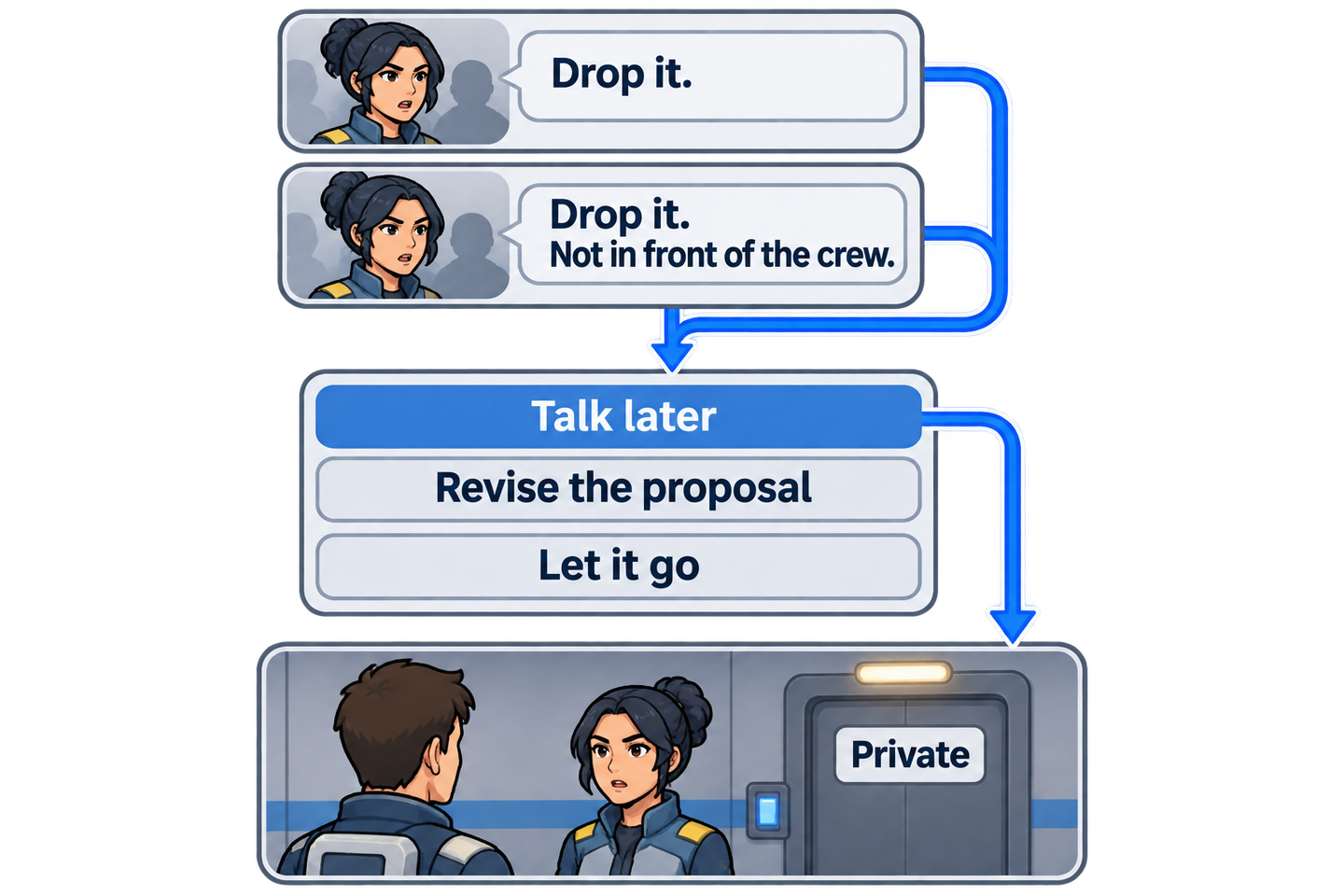
You ask a crewmate to back your proposal in front of the rest of the crew. “Drop it,” she says. You can ask her to talk after the meeting, revise the proposal, or let it go. If she resents being put on the spot, a private conversation makes sense. If she thinks the proposal is bad, moving the same pitch into the hallway changes nothing. The line tells you she’s had enough. It doesn’t tell you what she’s had enough of.

A believable outcome can still be hard to play
The designers of Prom Week ran into this problem while building a game in which players choose social exchanges for a cast of high school characters. In their design paper, Josh McCoy and colleagues give an example: the interface might show that two characters liked each other, yet Make Plans could still fail. The responder might be shy, or might remember when one of the initiator’s friends treated them badly. Either reason could make sense in the story. Neither was apparent from the fact that the characters liked each other.[1]
The team let players dig into the simulation’s reasoning. It also introduced a limited resource, social influence points, that players could spend before an exchange to reveal a response or its motives, or even change the outcome. Difficulty persisted in the beta, so the team also changed what it asked players to accomplish. It rewrote goals to match the clearest intentions behind the exchanges, making it easier to see which parts of the social state mattered and which actions could change them.[1]
That history doesn’t tell us how much a refusal should explain. The paper’s evaluation covers reception and gameplay traces, not whether a particular cue helped players recover from a rejection. It does give designers two places to look when a player stalls: what the response says and whether the game offers an action that can address it.[1]
What would the player try next?
Write two versions of the crew meeting for a paper prototype. At the top of each script, give the crewmate one reason to refuse. On the first, the others are listening. She says, “Drop it. Don’t ask me to take sides in front of everyone.” On the second, the plan leaves the night shift understaffed. She says, “Drop it. That leaves the night shift working alone.” The player sees the whole reply before the next choices open. The writer picks the reason in advance and keeps it fixed for that scene. If both objections matter, keep “Drop it.” Naming only the audience could send the player into the hallway with the same unsafe plan. Keep the short reply, too, if the script gives her no particular reason.
The player still has the same three choices. Talking later gives the crewmate privacy. If privacy was her concern, she now has room to hear the proposal. If staffing was her concern, the night shift would still be short a person after a private talk. Revising the plan could address that objection. She can still turn down the revised plan.
For each objection, write one version with “Drop it” alone and one with the extra sentence. Make four assignments to each of those four scenes, shuffle the 16 assignments, and give each playtester one scene. Keep the cast, proposal, timing, and wording and order of the three choices the same. Record the player’s first choice, then ask what the crewmate objected to and what the player expects that choice to change. End the session there, before the crewmate answers again.
Compare the short and explicit lines within each reason. Does naming the objection help more players identify it and predict what their move can change? Among players who keep negotiating, see whether naming the audience leads more players to ask for a private talk and naming the staffing problem leads more of them to revise the plan. Count walking away separately. A player who gives her space can understand her objection just as well as one who changes the plan. If players ask for a private talk in both cases and expect her to agree, listen to what they think the hallway changes for the night shift. Four players per version can expose a misreading worth testing again. Similar counts in two groups leave open whether the cue helped. To find out whether the player can carry a new approach into the next exchange, someone would have to write that exchange and let players try it.
Keep the first pass to one exchange. Each reason you write has to stay true as the scene changes, and each implied remedy has to be something the game supports. If the next move already makes sense without the extra line, cut it. If no available move addresses the objection, fix the choices before adding more explanation. And if the scene is about sitting with a refusal you can’t fully explain, the useful choice may be whether to give the character space, not how to win her over.
Sources
- Prom Week: Designing past the game/story dilemma
paper · Primary source extracted on 2026-11-19 · Source accessed: