A player takes damage during several close encounters. Your game can use those events to reconsider the next encounter without deciding that the player dislikes combat. Before building a player model, name the decision it will change and how long that decision should last. A temporary signal deserves a carefully limited job.
Michael Booth’s 2009 Valve presentation describes Left 4 Dead estimating each Survivor’s intensity from events including damage, incapacitation and nearby enemy deaths. The estimate decays over time, with decay suspended during active engagement. The Director uses the highest estimate among the team to regulate threat population. These are descriptions of a shipped system, not direct measurements of emotion.[1]

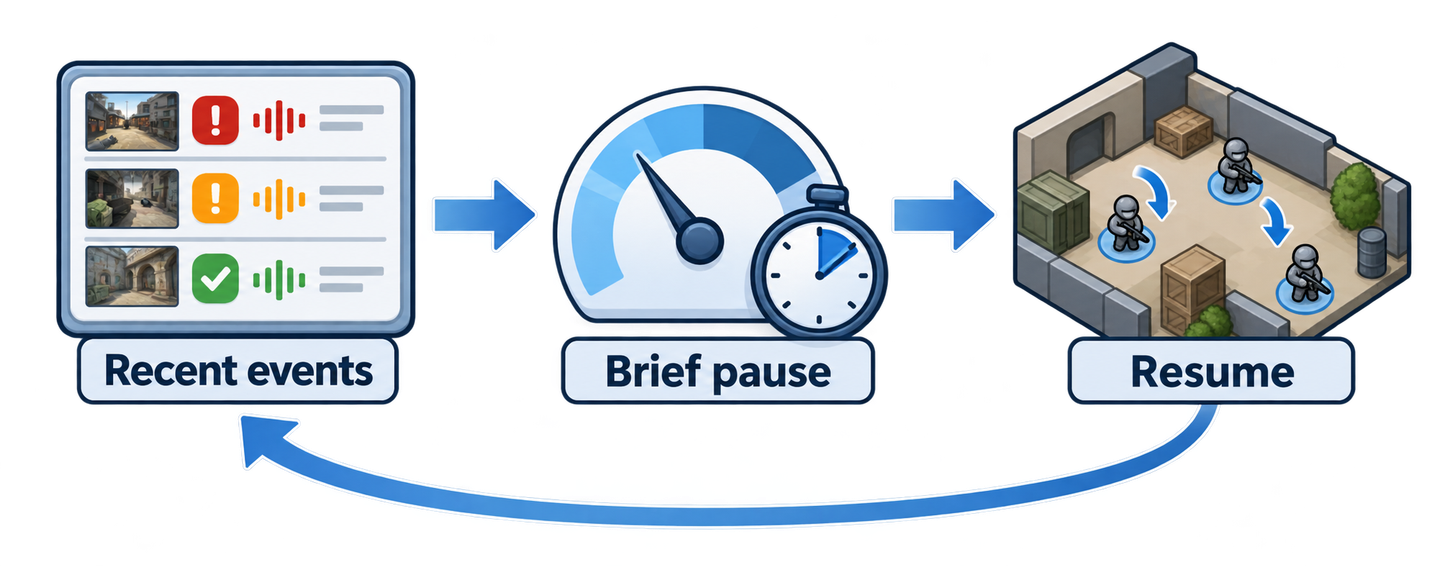
Keep the estimate close to its consequence
The adaptive-pacing slides describe build-up, a sustained peak, a fade while combat resolves, and a relax period. Existing special enemies may still attack during relaxation, and boss encounters remain outside this pacing adjustment. The concluding pacing slide distinguishes changing encounter frequency from changing difficulty. This account does not establish a lasting preference classifier or an effect size for another game.[1]
For a small co-op combat prototype, the design question might be whether to delay one new encounter after a demanding exchange. That proposal needs a record of recent events and the current encounter state. It does not need a permanent label such as cautious player. Keep the information for this decision separate from any future claim about what someone enjoys.
Applying this to your game
Begin with an existing authored encounter schedule as the recoverable baseline. Add one proposed controller that can postpone a new encounter within an authored interval only when recent events meet a criterion chosen by the team. For a first prototype, the team might flag repeated damage during the current exchange; its time window and trigger level remain untested design choices. When the criterion is not met, leave the baseline schedule unchanged. Let current enemies resolve under their normal rules. Define what ends the delay before testing it: a clear encounter boundary plus a time or progress limit that your team has deliberately chosen. These are proposed constraints, not a reproduction of Valve’s exact algorithm.
Inspect the event record beside the controller’s actions. A damage event, an estimate increase, a delayed spawn and the player’s account are separate observations. Check whether the player was under pressure, deliberately trading health for speed, or dealing with an unclear attack cue. The same damage total can accompany different plans. Ask what the person was trying to do and compare the account with the visible encounter before treating the delay as useful.
A team with one encounter already working can reserve its next iteration for a single signal, the delay rule, a debug view and a switch back to the authored schedule. Give up additional signal combinations during that pass. The programmer and encounter designer must agree on which threats the controller can postpone and how pending spawns survive a switch. If the existing encounter cannot safely pause, keep the fixed schedule until that dependency is resolved; a new player model does not remove the integration work.
Test the recovery path as part of the proposal. Return to the baseline while an encounter is waiting, then inspect whether it appears twice, disappears, or arrives without its intended warning. Keep a saved configuration and event sequence for each failure. A controller that can be disabled only by restarting a long session creates a larger correction cost than its temporary promise suggests.
Look for the cost of a wrong pause
Change the rule if a later observation shows that the pause interrupts a coordinated push or leaves players waiting for the next meaningful action. A successful survival rate alone cannot settle that question. Conversely, if players cannot regroup because fresh threats continually arrive, inspect the schedule and its boundary conditions before inferring a stable skill or motivation. A fixed authored breather may be sufficient for this encounter.
For co-op, also inspect who drives the signal. Taking the maximum across the team makes the highest estimate govern shared pacing, potentially scheduling downtime for everyone. Whether that relieves the intended pressure requires observation. Decide whether that shared consequence fits the encounter you are making. Do not quietly convert a team-level pacing choice into separate hidden difficulty settings for each person.
Booth’s account supports considering a rough, temporary estimate for a narrow control problem. The controller described here remains an unimplemented proposal. It supplies no current engine benchmark, privacy assessment, validated emotion measure or evidence that players want adaptation. Keep the authority to infer and the authority to intervene visible in the design.[1]
Sources
- The AI Systems of Left 4 Dead
article · Michael Booth, Valve, 2009; official 95-page slide PDF · Source accessed: