A tutorial highlights the correct switch, the player presses it, and the path opens. That can be a successful piece of assistance. If the game promises that the player will choose the next switch independently, the highlighted action leaves a further question: can they use the track layout when the directional cue is absent? The tutorial needs room to ask that question before it claims to have taught the rule.[1]
Koedinger, Pavlik, McLaren and Aleven frame the assistance dilemma around when instruction should provide information and when learners should generate a response. They distinguish immediate performance from later outcomes such as transfer and retention, while treating instructional time as a cost. Their 2008 paper develops the argument through practice spacing and examples versus problems. It provides no validated assistance schedule for this proposed game.[1]
Choose the capability before removing help
In a proposed path puzzle, the player must follow a visible track to decide which of two switches opens the route. The first encounter can show the relevant connection and demonstrate a choice. A later encounter can keep the controls and track readable while removing the instructional arrow. Change the track arrangement enough that remembering the first button is insufficient, while retaining the same rule. The designer must inspect that distinction before treating the second encounter as useful evidence.[1]

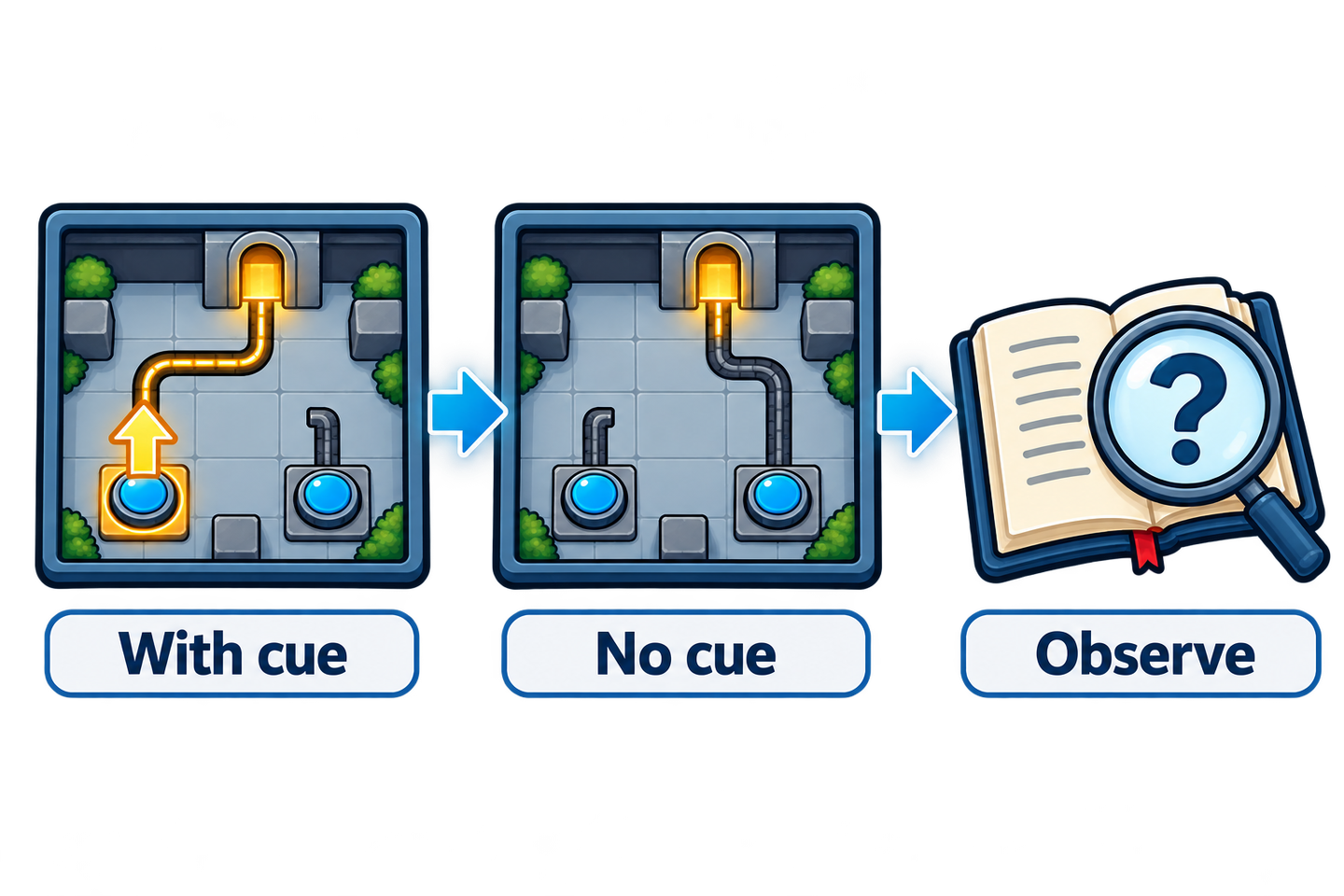
Keep navigation, text size and input access available. Removing a directional answer cue is a different change from removing the means to read or operate the puzzle. Offer help if the player wants it, and record that request separately from an attempt made without the cue. Someone who requests assistance has not failed the game’s broader purpose merely because they declined this particular exercise.[1]
Decide what observation the current build can support. An immediate attempt on a rearranged instance can reveal how the player applies the same rule under those conditions. It cannot establish what they remember next week, how they handle a different mechanic, or whether the tutorial caused a change. A player may already know the rule. If the team needs a causal claim about the tutorial, it needs an appropriate comparison and study design beyond watching this sequence.[1]
Reserve content and time for the next attempt
For a small tutorial revision, budget the demonstrated puzzle, one carefully checked later instance and a route back to help before building automatic ability classification. The designer owns which relation both instances require. The developer controls the answer cue independently of the ordinary interface. The researcher records prior familiarity, what assistance appeared and what the player did. Those records matter because a completed puzzle can result from reasoning, guessing or remembered button placement.[1]
This allocation gives up some tutorial variety. A team with time for only one encounter can prioritize clear assistance and describe the observed result as supported completion. A project whose goal is immediate access may prefer that choice. Independent practice earns its cost when later unaided use is part of the experience the game actually promises; it should not become an extra gate imposed on every player.[1]
The paper’s example-problem discussion treats the mixture of provided steps and requested steps as an unresolved modeling problem. The authors explicitly note that the three-condition comparison needed to establish their proposed curve had not been performed to their knowledge at that time. Its diagram is not a measured optimum for our puzzle. A fixed rule to remove help after one success would go beyond this evidence.[1]
Let the observation change the assistance
Watch the next attempt and ask about the relevant connection when that question suits the game and participant. If players can trace the track but cannot activate a switch reliably, repair the interaction. If they repeat the first button without inspecting the new arrangement, revise the demonstration or the second instance. If they can act but dislike explaining it, inspect their actions instead of making verbal explanation the sole criterion.[1]
Keep the earlier help available while testing the revision. Restore or strengthen guidance when removing it prevents useful play, and reconsider the learning goal when players primarily want relief or progress. Only propose delayed or unfamiliar-case checks if the project needs those conclusions and can fund the content and participation. The current sequence can answer a narrower question well: what can this player do with this rule after this cue disappears?[1]
Sources
- Is it Better to Give than to Receive? The Assistance Dilemma as a Fundamental Unsolved Problem in the Cognitive Science of Learning and Instruction
paper · Koedinger, Pavlik, McLaren and Aleven; CogSci 2008, pp.2155–2160; author-hosted published PDF · Source accessed: