The player returns a stolen compass to a harbor keeper just as the warehouse alarm sounds. The keeper has a reason to thank them and a reason to send them toward the fire. If the next line warmly recalls the compass while smoke fills the doorway, every remembered fact may be correct. The scene still makes the keeper seem unaware of what matters now.
For this proposed scene, give the alarm priority and leave the thanks available for a quieter encounter. That choice changes which memory is expressed. It does not undo the returned compass, erase the keeper’s gratitude or promise that a later conversation will always occur.

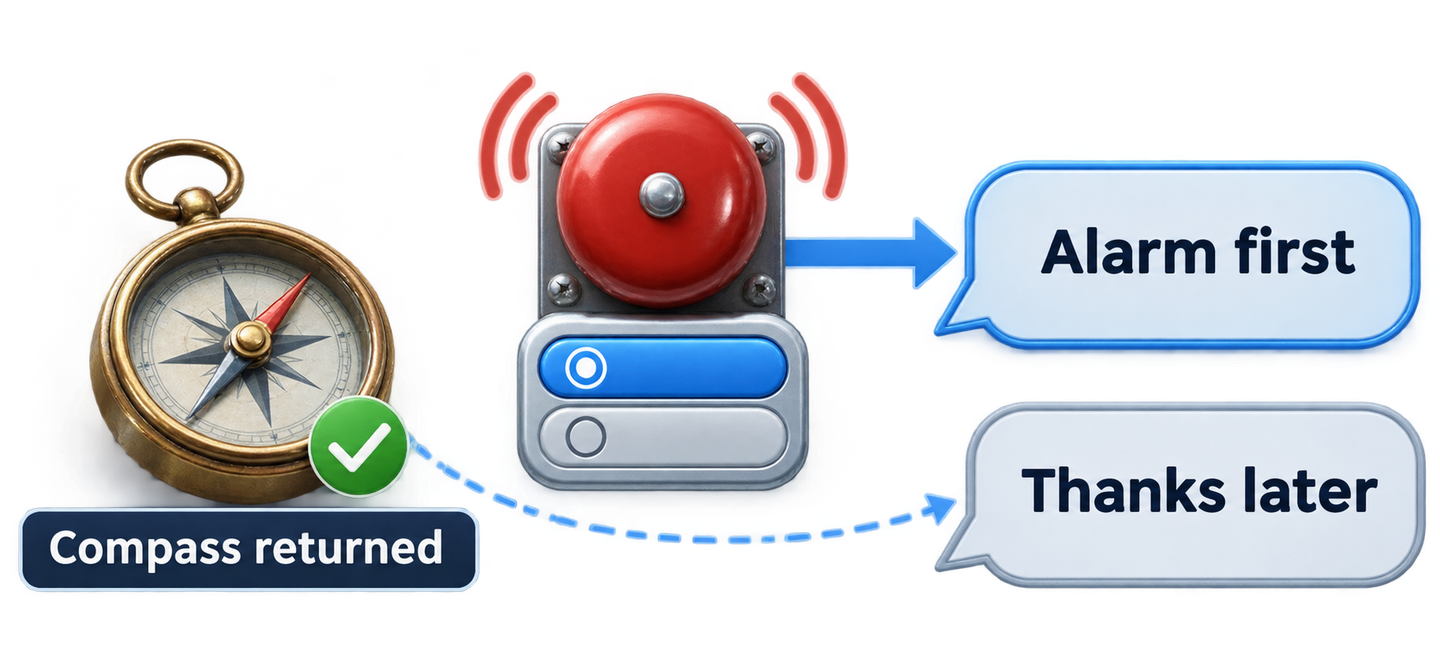
A matching fact does not choose the line
Emily Short describes salience-based narrative as selecting the most applicable content from a pool. Her kitchen example has two equally specific lines that can match together; the example chooses randomly between them. She also describes adding more specific responses around broad defaults and discusses the difficulty of tuning selection when it controls story progression. These are design observations from her 2016 essay, rather than evidence that any particular priority scheme improves a game.[1]
The harbor scene needs a decision beyond checking that both lines are allowed. One line acknowledges an earlier action; the other points to an immediate event. A random tie would occasionally give the thanks priority. That could suit a distracted or comic keeper, but it conflicts with this version’s intended urgent response.
Keep the event and the response separate
Start with the two authored lines and a neutral fallback. Returning the compass records that event. The alarm determines whether the urgent response is currently appropriate. A separate record says whether the keeper has already delivered the thanks. Write those meanings down before combining them into a single conversation score.
At the encounter, first check which lines are eligible, then apply the scene’s priority rule. When the alarm wins, leave the thanks undelivered. If the player returns after the fire and the callback is still appropriate, the keeper can thank them then. If the keeper has left or died, the game need not invent another conversation to satisfy an internal queue. The earlier event can remain true without every consequence being shown.
The extra work is a response-priority rule, a distinction between an event and its acknowledgment, and authored coverage for their overlap. Save and reload behavior also needs checking if the scene can be interrupted. Spend that effort on this promised callback before adding a larger collection of remembered objects. A cheaper version can mention the compass only in a dedicated calm conversation and give up the chance of acknowledging it during the emergency.
Avoid marking the thanks as delivered merely because it was eligible. Advance that record when the line actually appears. Otherwise an interrupted exchange or a higher-priority line can consume a response the player never heard. This is a proposed implementation requirement for the example, not a claim about Short’s systems or a tested engine behavior.
Test the collision before expanding the archive
Plan local checks for compass returned with and without the alarm, an interrupted exchange, and a later return after the alarm ends. Inspect both the selected line and the retained event. A passing check would show that this small state model follows its own rules; it would not establish that players notice or value the callback.
In a later playtest, ask what the keeper appeared to remember and why they changed the subject. If people understand the emergency but find delayed thanks jarring, rewrite its timing or remove it. If they value the keeper’s misplaced politeness, reconsider the priority rule rather than treating every odd response as a storage failure. No prototype or player session has been run for this scene.
Sources
- Beyond Branching: Quality-Based, Salience-Based, and Waypoint Narrative Structures
article · First-party 2016 authored essay; scoped body read 2026-11-08 · Source accessed: